Introduction
Runtime surprises mid-shoot almost always trace back to one thing: a misread spec sheet. The 600Wh figure on a lithium battery pack is the most cited number in professional power planning — and also the most misunderstood.
In cinema and broadcast production, where a BMS-triggered shutdown can interrupt a live take or kill a high-speed camera in the middle of a capture, reading that number correctly isn't optional. It's operational.
What follows covers what 600Wh actually represents in a 48V lithium pack and how voltage behaves across a real discharge cycle. It also addresses what reduces usable capacity in field conditions — and which spec misreads lead to over-discharge, equipment resets, and premature pack replacement.
Key Takeaways
- 600Wh is stored energy, not output power: calculated as 48V × 12.5Ah; runtime equals 600Wh ÷ load watts
- Actual usable capacity falls below 600Wh due to BMS cutoffs, discharge rate, and temperature effects
- A LiFePO4 pack's voltage spans roughly 44V–58.4V across the discharge cycle; "48V" is a nominal rating, not a fixed operating voltage
- High-current loads and elevated temperatures reduce delivered watt-hours, sometimes significantly
- Operating outside rated voltage limits risks permanent capacity loss and equipment shutdown
What 600Wh Represents in a 48V Lithium Battery Pack
What the Wh Rating Actually Measures
The formula is E = V × Ah. For a 48V pack with 12.5Ah of capacity, that gives you 48 × 12.5 = 600Wh. IATA confirms this as the standard method for calculating watt-hour ratings on lithium-ion batteries.
The Wh rating tells you the pack's total energy budget — how much electrical work it can do before it needs recharging. It says nothing about delivery rate. That's power, measured in watts, and it's a completely separate figure.
A pack rated at 600Wh can theoretically run a 200W load for 3 hours, or a 600W load for 1 hour. The energy budget is the same. The rate changes.
The Design Ceiling vs. Delivered Reality
600Wh is set by cell chemistry and configuration — it's the theoretical maximum under controlled lab conditions, not a figure users can adjust or exceed in the field. Real-world delivery is always lower, for reasons covered in the next section.
How 48V Is Built From Cells
For LiFePO4 cells with a nominal voltage of 3.2V per cell:
- 15S configuration: 15 × 3.2V = 48.0V nominal
- 16S configuration: 16 × 3.2V = 51.2V nominal
Both are marketed as "48V" packs. A 16S pack charging to 58.4V and a 15S pack charging to 54.75V have different energy windows, even if the label says the same thing. Always check the actual series count and voltage window on the spec sheet, not just the marketing voltage.
Factors That Influence Delivered Energy in Real-World Use
Rated capacity and field capacity are not the same number. Four variables drive the gap:
Discharge Rate (C-Rate)
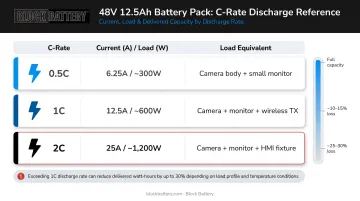
Battery University defines 1C as a discharge rate that empties the pack in one hour. For a 12.5Ah pack, 1C = 12.5A, or 600W at 48V.
Push past 1C and available watt-hours drop. Battery University's discharge characteristic data shows that a cell rated at 3.2Ah delivers roughly 2.3Ah at 2C — a reduction of nearly 30% — because the discharge cutoff voltage is reached before full capacity is extracted. The same mechanism applies to pack-level behavior under high-current cinema lighting or multi-camera loads.
Practical C-rate reference for a 48V 12.5Ah pack:
| C-Rate | Current | Load Equivalent |
|---|---|---|
| 0.5C | 6.25A | ~300W |
| 1C | 12.5A | ~600W |
| 2C | 25A | ~1,200W |
Temperature
EVE LFP cell data shows discharge capacity at ≥80% at 0°C and ≥70% at -20°C under standard conditions. Cold-weather shoots (exterior locations, overnight productions) reduce usable energy significantly. A 600Wh-rated pack operating at -20°C may deliver closer to 420Wh before cutoff.
BMS Cutoff and State of Health
The BMS engages a protection threshold above the hard cell minimum (2.5V/cell per EVE specifications), cutting output before the cells are fully drained. As a pack ages, two effects compound that gap:
- Internal resistance rises, reducing peak current delivery
- Capacity fades — a pack delivering 580Wh in year one may drop noticeably lower after several hundred deep cycles
EVE's recommended operating window of 10%–90% state of charge means the manufacturer already builds a usable range below the nameplate figure into the design.
Operating Range and Voltage Boundaries of the 48V 600Wh Pack
Nominal Operating Range
A 48V LiFePO4 pack does not sit at a fixed 48V. Voltage varies throughout the discharge cycle:
| Configuration | Full-Charge Voltage | Nominal Range | Cell-Level Cutoff |
|---|---|---|---|
| 15S LFP | ~54.75V | ~48V | ~37.5V (2.5V/cell) |
| 16S LFP | ~58.4V | ~51.2V | ~40.0V (2.5V/cell) |
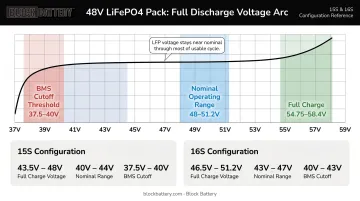
One of LFP's most useful characteristics: its discharge plateau is exceptionally flat. Research published in the Journal of Power Sources confirms a "very flat region" in the LiFePO4 voltage curve, meaning voltage stays close to nominal through most of the usable range. That makes SOC estimation harder by voltage alone — but it also means equipment sees stable voltage for the bulk of the cycle.
Those stable-voltage conditions apply under specific test parameters: approximately 25°C, a discharge rate between 0.2C and 0.5C, and discharge to the rated cutoff voltage.
Allowable Tolerance and Boundary Limits
Key voltage boundaries:
- Upper limit (charge cutoff): 3.65V per cell maximum — 54.75V for a 15S pack, 58.4V for 16S
- Lower limit (discharge cutoff): 2.5V/cell hard minimum per EVE specification, with BMS protection engaging before that threshold
Short-term voltage sag under heavy load is tolerable — packs are designed to handle brief excursions. Sustained operation near the discharge floor is not. It accelerates capacity loss and risks permanent cell damage.
Safe Operating Margin
EVE's own 10%–90% SOC recommendation effectively targets an 80% usable depth of discharge. Staying within that window preserves cycle life substantially. Elevated temperature compounds the effect: EVE's LF50K data lists ≥7,000 cycles at 25°C versus ≥2,500 cycles at 45°C under 1C cycling — nearly a 3× difference in cycle life based on operating temperature alone.
For production teams running batteries through long shoots or rental rotations, staying within the 80–90% DoD window and avoiding heat exposure has a direct cost consequence. A pack managed within these boundaries can last two full seasons; one that isn't may need replacement mid-rental contract.
Key Technical Properties Defined by the 600Wh Rating
Energy Density and Physical Form Factor
LiFePO4 trades energy density for safety and longevity. EVE's LF50K cell achieves approximately 115 Wh/kg at the cell level — lower than NMC equivalents, which can reach 200+ Wh/kg. A 600Wh LFP pack will be physically larger and heavier than a 600Wh NMC pack delivering equivalent energy. For cinema and broadcast applications where cycle life and thermal stability matter more than minimizing pack weight, that trade-off is usually worth it.
No verified pack-level weight figure for a generic 48V 600Wh LFP system was confirmed in the research for this article — always check the manufacturer's datasheet for the specific pack you're specifying.
Discharge Rate and Its Effect on Available Wh
The BMS maximum continuous discharge current rating sets the safe power ceiling. It must be checked against your connected load's peak draw, not just its continuous draw. Running a cinema light that spikes at startup above the BMS continuous current limit risks triggering protection shutdown at the worst possible moment.
For sustained high-current draw scenarios, verify that your 600Wh pack's BMS is rated for the combined load of your rig. Lighting arrays, gimbal systems, and multi-camera setups each present different peak-draw profiles that a BMS spec sheet will clarify.
Capacity Fade and Cycle-Life Relationship
Capacity doesn't stay at 600Wh indefinitely. The EVE LF100M data provides a useful reference: 2,000 cycles at 25°C brings capacity to 80% retention — meaning a 600Wh pack may deliver around 480Wh after equivalent use. At 45°C, that retention threshold arrives after fewer than 1,000 cycles.
For mission-critical production work, particularly rental house fleets cycling packs through multiple productions, this directly affects spec planning. A pack specified at 600Wh in year one needs recalibration or replacement planning before it can no longer meet the runtime requirement it was originally sized for.
How 600Wh Capacity Is Specified and Validated
Reading the Datasheet Critically
A properly documented pack datasheet should include:
- Nominal voltage and rated Wh — the foundational energy spec
- Rated Ah — confirms the V × Ah math; if it doesn't reconcile, question the rating
- Charge cutoff voltage — upper operating boundary
- Discharge cutoff voltage — lower boundary and BMS protection threshold
- Maximum continuous discharge current — the safe power ceiling; exceeding it triggers thermal derating or BMS cutoff
- Operating temperature range — defines performance envelope
- Cycle life — at a defined DoD and temperature
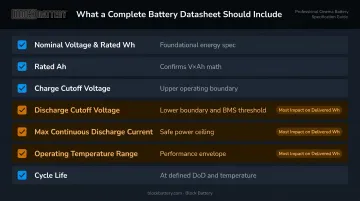
The three parameters that most directly affect delivered Wh are discharge cutoff voltage (how far the pack actually discharges), max continuous current (the C-rate ceiling), and operating temperature range (thermal derating). Each one can shave real capacity off a lab-rated number.
Lab ratings apply under controlled conditions. Packs validated against real production load profiles — not just bench tests — give you more reliable runtime predictions on set. IEC 61960-3:2017 defines the formal framework for secondary lithium cell and battery performance testing.
Field Verification
600Wh can be verified in the field using a watt-hour meter capable of integrating voltage and current over a full discharge cycle. Measure at rest rather than under active load for baseline accuracy.
Field verification is approximate — load-dependent and subject to environmental variables. It's useful for flagging capacity degradation, but doesn't replace controlled discharge testing. For rental houses cycling packs through regular productions, that distinction matters: periodic capacity testing is the only reliable way to catch degradation before it becomes a runtime failure on set.
Block Battery also manufactures a Cartridge Analyzer & Balancer compatible with several SLi-series models, capable of balancing and analyzing up to 10 battery cartridges simultaneously — a practical tool for fleet-level health monitoring at rental houses.
Operating Outside Rated Limits: Risks, Misinterpretations, and What to Avoid
What Actually Happens at the Boundaries
- Over-discharge: Research published in the Journal of the Electrochemical Society documents that extreme over-discharge can raise anode potential high enough to dissolve copper current collectors — a mechanism associated with internal shorts and permanent cell damage. Runtime shortens, and the damage compounds with each subsequent cycle.
- Overcharge: European Commission JRC safety research identifies overcharge as a primary thermal runaway initiation route, linked to electrolyte decomposition and material phase instability.
- Sustained high-rate discharge: Accelerates both thermal and electrochemical degradation, narrowing the gap between rated and delivered capacity faster than moderate use.
Common Misinterpretations to Avoid
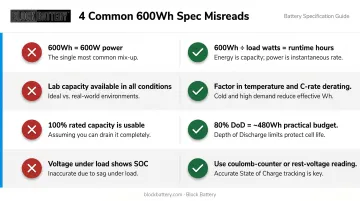
These are the errors that cause real production problems:
- Treating 600Wh as 600W of available power. It is not. Runtime = 600Wh ÷ load watts. At 300W, you have roughly 2 hours — less with efficiency losses.
- Assuming lab-rated capacity is available in cold or high-current field conditions. It isn't. Factor in temperature and C-rate derating before specifying runtime.
- Ignoring the difference between 100% rated capacity and 80% DoD usable energy. The practical energy budget for a 600Wh pack operated at 80% DoD is closer to 480Wh.
- Using under-load voltage readings to estimate remaining capacity. Voltage sags under current draw and recovers at rest. LFP's flat discharge curve makes voltage an unreliable SOC indicator anyway. Use a coulomb-counting monitor or rest-voltage measurement for accurate state-of-charge readings.
Safety, Transport, and Warranty
Operating outside the BMS-defined voltage window typically voids manufacturer warranty. For packs used in professional production environments, overcharge and thermal events carry real risk to personnel and equipment.
Shipping a 600Wh pack requires planning. PHMSA classifies lithium-ion batteries by watt-hour rating, and a 600Wh pack triggers large lithium-ion battery requirements across the board:
- Exceeds the 100Wh standard small-battery threshold
- Exceeds the 300Wh highway/rail-only threshold
- Forbidden as cargo on passenger aircraft (UN3480)
- Must ship at ≤30% SOC on cargo aircraft under IATA/PHMSA rules
Build shipping SOC and carrier restrictions into your production logistics before the pack leaves the facility.
The gap between rated and delivered capacity is real and measurable — but it's predictable. Read the spec sheet correctly, account for temperature and load, and the 600Wh figure becomes a reliable planning number rather than a source of on-set surprises.
Frequently Asked Questions
How long does a 600Wh battery last?
Divide 600Wh by your load in watts: a 200W load gives approximately 3 hours, a 600W load approximately 1 hour. Real-world runtime runs shorter due to inverter efficiency losses, a practical 80% DoD limit, and discharge rate effects. Plan for roughly 80–85% of the theoretical figure.
How many lithium cells are needed for a 48V battery?
For LiFePO4 (3.2V nominal per cell), a 15-cell series (15S) yields 48V nominal; a 16-cell series (16S) yields 51.2V, also marketed as "48V." To reach 12.5Ah for a 600Wh pack, parallel groups of cells are added to reach the required amp-hour capacity.
What is the difference between Wh and Ah in a 48V battery?
Ah measures charge capacity at a given voltage; Wh measures total stored energy. For a 48V pack: Wh = 48 × Ah, so 12.5Ah equals 600Wh. Wh is the more useful figure when comparing packs across different voltage levels, since it accounts for both voltage and capacity in a single number.
What voltage range does a 48V lithium battery actually operate at?
A 48V LiFePO4 pack charges to approximately 54.75V (15S) or 58.4V (16S) and discharges to around 37.5–40V before BMS cutoff. The flat LFP discharge plateau keeps voltage near 48–51V through most of the usable cycle, though actual resting voltage depends on state of charge and configuration.
How do you calculate lithium content for shipping purposes?
Current IATA and DOT regulations classify lithium-ion batteries by watt-hours, not by an equivalent lithium content formula. A 600Wh pack exceeds both the 100Wh standard threshold and the 300Wh highway/rail-only threshold. It is regulated as a large lithium-ion battery (UN3480) with specific air freight restrictions. Consult your carrier and current IATA DGR for applicable requirements.
How many batteries do I need for a 600W load?
A single 600Wh pack can theoretically supply a 600W load for approximately one hour — in practice, closer to 45–50 minutes after applying an 80% DoD limit and efficiency losses. For two hours at 600W, two packs in parallel is the baseline; confirm the BMS and output configuration support parallel operation before connecting.