LiFePO4 (LFP) batteries are widely regarded as the safest lithium chemistry available. That said, "safe" is not unconditional — it depends on the chemistry, how the battery is handled, and whether basic operating practices are followed.
This guide covers the science behind LFP safety, practical handling guidelines, and the most common mistakes that compromise even the safest batteries.
Key Takeaways
- LFP's iron phosphate-oxide cathode resists heat and releases minimal oxygen during thermal events, sharply limiting fire risk compared to cobalt-based chemistries
- A functioning Battery Management System (BMS) is non-negotiable — without it, the three leading failure causes go unchecked
- Charger compatibility is the most preventable and most overlooked source of LFP battery damage
- Even LFP chemistry has limits: severe overcharging, physical damage, or sustained heat can still cause failure
What Makes LiFePO4 Batteries Safe?
The Chemistry Advantage
LFP's safety advantage starts at the cathode. The iron phosphate-oxide (Fe-PO₄) bond is structurally stronger than the cobalt-oxide bonds used in NMC (nickel manganese cobalt) or NCA (nickel cobalt aluminum) batteries. Under heat, overcharge, or mechanical stress, this bond resists breakdown — which is what prevents the chain reactions that lead to thermal runaway.
Peer-reviewed research confirms that olivine LiFePO4 cathodes are highly stable and do not release substantial oxygen at elevated temperatures, unlike layered oxide cathodes used in NMC and NCA chemistry. For production teams running high-capacity batteries on set, that difference is what separates a manageable fault from a fire.
Why Oxygen Release Is the Real Danger
In cobalt-based lithium batteries, overheating causes the cathode to release oxygen. That oxygen feeds combustion internally, creating a self-sustaining thermal event — thermal runaway. Once it starts, it's difficult to stop.
LFP avoids this mechanism. Without significant oxygen release, the chain reaction cannot self-sustain at the cathode level. In material-level testing, delithiated LFP (LFP in its charged state) maintains stability at temperatures far exceeding those that destabilize NMC cathodes — where oxygen-releasing phase transitions have been observed between 250°C and 350°C.
What "Incombustible" Actually Means
LFP batteries will not ignite under common mishandling. That covers the scenarios most relevant to production use:
- Rapid charge/discharge cycles during back-to-back shooting days
- Short circuits from damaged connectors or tap accessories
- Minor physical impacts from normal set handling
This is not unconditional immunity, though. Under extreme abuse — catastrophic physical damage, severe and sustained overcharging, or prolonged external heat — failure is still possible.
Important clarification on electrolyte: LFP batteries use conventional lithium-ion electrolytes (typically LiPF6 in organic carbonate solvents), which are flammable. The primary safety advantage comes from the cathode's thermal stability and low oxygen-release tendency — not from an inherently non-flammable electrolyte. Do not treat LFP packs as fireproof.
LFP vs. Other Lithium Chemistries
| Factor | LFP | NMC / NCA |
|---|---|---|
| Cathode oxygen release | Very low | High under thermal stress |
| Thermal stability | High | Moderate to lower |
| Common abuse failure risk | Lower | Higher |
| Toxic materials | None (no cobalt/nickel) | Contains cobalt/nickel |
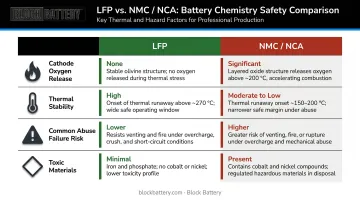
The toxic materials row matters beyond environmental optics — cobalt and nickel compounds present disposal and handling considerations that LFP chemistry sidesteps entirely.
Safety Guidelines for LiFePO4 Batteries
LFP's chemistry advantage reduces the ceiling of failure severity — it does not eliminate all risk. Consistent handling discipline and correct system configuration still determine whether a battery performs safely over its service life.
General Safety Precautions
Baseline rules that apply every time an LFP battery is handled:
- Never drop, puncture, or attempt to open the battery casing
- Do not short-circuit terminals or modify connectors
- Use only manufacturer-approved cables and connectors rated for the battery's output
- Do not charge or operate a battery showing swelling, unusual heat, visible damage, or unfamiliar odors
- Always confirm BMS functionality before use — a properly functioning BMS monitors voltage, temperature, and current in real time, blocking overcharging, over-discharging, and short circuits
Operating any LFP battery without a functioning BMS negates the chemistry's built-in safety advantage.
Safety During Storage and Installation
Storage recommendations (based on manufacturer documentation):
- Store at approximately 50% state of charge for long-term storage
- Keep within the manufacturer-specified temperature range — one LFP instruction manual specifies -4°F to 113°F (-20°C to 45°C)
- Store away from direct heat sources, moisture, and flammable materials
During installation:
- Insulate terminals before making connections
- Use torque-correct fasteners — loose connections generate resistance and heat
- Verify your charging system is calibrated for LFP voltage profiles before connecting
Never assume a charger designed for lead-acid or NMC batteries is compatible with LFP packs without explicit confirmation.
Safety While Operating
LFP cells have specific voltage limits that must be respected:
- Nominal cell voltage: 3.2V
- Maximum charge voltage: 3.65V per cell (typical)
- Minimum discharge cutoff: 2.5V per cell (typical)
- Safe charging temperature: approximately 0°C to 55°C (32°F to 140°F)
- Safe discharge temperature: approximately -20°C to 55°C (-4°F to 140°F)
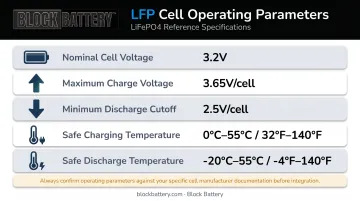
These are typical manufacturer values — always confirm limits against your specific battery's documentation, as cell design varies.
For professionals using high-draw equipment — cinema cameras, lighting rigs, or broadcast gear — monitor battery temperature during extended high-load sessions and allow cooling time between sustained heavy discharge cycles.
Block Battery's production-focused systems, including the INDY series for large lighting arrays and the SLi series for camera and mid-tier production loads, are engineered for sustained-current professional environments. Even so, no battery is exempt from basic thermal management.
Environmental and System Safety
Voltage and temperature limits don't exist in isolation — the environment where a battery operates shapes its long-term safety as much as any single session.
Cold weather presents a specific charging hazard: temperatures below 0°C/32°F can cause metallic lithium plating on the anode, a risk confirmed by OSHA's lithium battery safety guidance. Plating degrades cell capacity over time and can create internal short-circuit risk. Some batteries include low-temperature charging protection; not all do.
Hot environments carry a different risk. Sustained exposure above the battery's maximum operating temperature accelerates degradation and increases the likelihood of failure — even with chemistry as stable as LFP.
Multi-battery setups require extra discipline. Only connect batteries of the same chemistry, capacity, and charge state. Mismatched batteries in parallel create cell imbalance that degrades individual cells unevenly over time. Always isolate the battery from the load before making or breaking connections, and use appropriately rated fuses between battery and load.
Common Safety Mistakes to Avoid
Using Incompatible Chargers
This is the most documented preventable risk. CPSC has explicitly warned that even good batteries can catch fire when used with incompatible chargers. A charger not calibrated for LFP voltage profiles can overcharge individual cells even when total pack voltage appears normal.
Cell-level overcharge causes gradual degradation, often with no visible external warning until significant internal damage has already occurred.
Always use chargers approved by the battery manufacturer for LFP chemistry specifically.
Ignoring Early Warning Signs
Warning signs identified by OSHA and NFPA include:
- Unusual or unfamiliar odors
- Swelling or bulging of the battery casing
- Excessive heat beyond what the load would normally produce
- Popping or hissing sounds
- Voltage readings outside the normal operating range
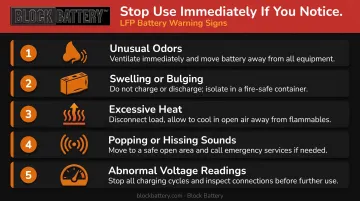
Treating these as minor variations is a mistake. Continued operation after warning signs appear sharply raises failure risk. Stop use, isolate the battery, and have it assessed before returning it to service.
Assuming LFP Is Unconditionally Safe
LFP's reputation for safety leads some users to skip pre-use inspections, ignore BMS error indicators, or store damaged batteries without addressing the issue. The chemistry is highly stable — but it cannot compensate for a failed BMS, a damaged casing, or improper storage. Build inspections and BMS checks into your standard pre-shoot checklist, just as you would with any other production-critical equipment.
Conclusion
LiFePO4 batteries are genuinely among the safest energy storage technologies available. That advantage is grounded in their fundamental cathode chemistry — specifically, high thermal stability and low oxygen-release tendency under stress — not in marketing language. That chemistry advantage only holds, however, when the rest of the system supports it.
Correct charging, proper storage, attentive operation, and consistent pre-use inspection are what keep that advantage intact across a battery's service life. For cinema, lighting, and broadcast professionals, equipment failure mid-production isn't just inconvenient — it's costly. Following the guidelines in this article and using LFP systems purpose-built for production demands gives you both the chemistry and the operational framework to work with confidence.
Frequently Asked Questions
Are lithium iron phosphate (LiFePO4) batteries safer than other lithium-ion batteries?
Yes. LFP's stronger iron phosphate-oxide cathode bond, higher thermal stability, and significantly lower oxygen-release tendency make it safer than cobalt-based chemistries like NMC or NCA, particularly under overcharging or physical damage. The risk of thermal runaway propagating into combustion is substantially lower.
Are lithium iron phosphate (LiFePO4) batteries safe to store and use at home?
LFP batteries are well-suited for indoor use — they do not emit toxic fumes, are not prone to spontaneous ignition under normal conditions, and do not contain corrosive liquid electrolytes that could leak. Standard storage practices still apply: store at partial charge (around 50% SOC) and away from heat sources.
Can LiFePO4 batteries catch fire or explode?
Under most abuse conditions, LFP batteries are highly resistant to fire and do not explode. Under extreme abuse (catastrophic physical damage, severe overcharging, or prolonged external heat) failure can still occur. This is precisely why BMS protection and correct operating practices are essential, not optional.
What is thermal runaway and how does LFP chemistry prevent it?
Thermal runaway is a self-sustaining overheating chain reaction in which heat causes cathode oxygen release, which feeds internal combustion, which generates more heat. LFP prevents this by not releasing substantial oxygen during thermal events, and its cathode structure remains stable at temperatures that would destabilize NMC or NCA cathodes.
Do LiFePO4 batteries need a Battery Management System (BMS)?
A BMS is essential: it monitors cell voltage, temperature, and current in real time, preventing overcharging, over-discharging, and short circuits before they cause damage. Running an LFP battery without one removes the primary layer of electronic protection and negates much of the chemistry's built-in safety advantage.
What certifications should I look for in a safe LiFePO4 battery?
For portable professional packs, look for IEC 62133-2 (or UL 62133-2 in North America) and UN 38.3 for transport safety. IEC 62619 applies to industrial battery systems. Confirm that certifications match your specific product category, as scope varies between standards.