Introduction
Picture this: you're mid-setup on a feature film shoot. The ARRI Alexa 35 is locked off, lighting is dialed in, and the director calls action. Then the battery dies. Not a depleted cell — the whole pack fails. One component takes down the entire power system. Now you're looking at a costly delay while someone scrambles to replace a unit that could have been swapped in minutes.
That scenario plays out more than crews like to admit. And according to Block Battery's own production framing, a missed take on a feature film shoot day can cost five to seven figures in lost production time — a number that puts battery reliability in an entirely different category of risk.
Modular batteries exist precisely to break that single-point-of-failure model. Instead of one fixed pack, you get a system of discrete, interchangeable units that scale, swap, and adapt to whatever the production demands.
Understanding how these systems work — and what separates a well-engineered modular system from a marketing label — is what this guide is built to deliver.
Key Takeaways
- Modular batteries connect in series or parallel to scale voltage or capacity without swapping the whole system
- Series connections increase voltage; parallel connections increase runtime (amp-hours)
- Failed modules swap out independently, cutting downtime to minutes rather than a full-pack replacement cycle
- Distributed modules manage heat more evenly than single large monolithic packs
- Feature film, broadcast, and aerial productions rely on modular systems for scalability, redundancy, and fast field serviceability
What Is a Modular Battery? Cells, Packs, and Modules Explained
Before the term "modular battery" means anything useful, three foundational concepts need to be clear. They're genuinely different things, and conflating them causes real confusion downstream.
Cells, Packs, and Modular Systems
- Cell — the fundamental electrochemical unit: anode, cathode, electrolyte, separator, and housing. Everything else is built from it.
- Battery pack — one or more cells combined with protection circuits and a Battery Management System (BMS). It's a finished, functional unit, but operates as a standalone system at fixed capacity.
- Modular battery — a battery pack specifically engineered to work in tandem with other identical packs. The key word is identical: same voltage, same chemistry, same capacity specifications. Matching specs is what enables true interchangeability and distinguishes a modular system from simply wiring packs together.
The BMS: What Makes It a System, Not Just Wiring
The Battery Management System is where the intelligence lives. IEEE 2686-2024 defines the BMS as a functionally distinct component with active functions needed to protect battery safety and longevity, covering:
- Cell balancing and voltage monitoring
- Temperature limits and current control
- Fault detection and system diagnostics
In a modular context, that matters enormously. Without a capable BMS, you get no coordinated protection across connected modules. With one, every pack in the system operates under shared oversight, which is what separates a true modular system from a collection of parts wired together.
Modular vs. Monolithic
Standard (monolithic) battery packs have a fixed capacity and a single-unit design. When they fail, you replace the whole unit. When your power needs grow, you replace the whole system.
Modular systems flip that logic. They're purpose-built for incremental growth, isolated replacement, and configuration changes without infrastructure overhaul. The constraint — that all modules must share manufacturer specs — is also the source of their reliability.
How Modular Batteries Work: Series and Parallel Connections
Understanding how modules connect — in series, parallel, or both — determines whether a system hits the right voltage, runtime, or both for a given production demand.
Series Connections: Building Voltage
Connecting modules positive-to-negative stacks voltage while keeping total capacity (amp-hours) constant.
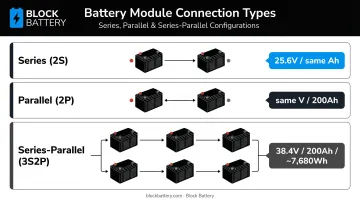
The math is direct: V_pack = Ns × V_cell, where Ns is the number of modules in series. Two 12.8V LiFePO4 modules in series yield 25.6V — useful when a device requires a higher operating voltage without needing more runtime at the base voltage.
Parallel Connections: Building Runtime
Connecting modules positive-to-positive and negative-to-negative does the inverse: voltage stays constant, capacity multiplies.
C_pack = Np × C_cell, where Np is the number of parallel strings. Two 100Ah modules in parallel gives 200Ah at the same voltage — the right configuration when a long shoot day demands extended runtime without changing the power profile.
Series-Parallel: Both at Once
Real production systems often combine both approaches. Consider six 12.8V / 100Ah modules configured as 3S2P (three series groups, two parallel strings):
- Voltage: 3 × 12.8V = 38.4V
- Capacity: 2 × 100Ah = 200Ah
- Total energy: ~7,680Wh
That configuration gives system designers precise control over voltage and runtime. NREL research confirms that large packs configured this way require active cell-level balancing to maintain performance — another reason BMS sophistication isn't optional.
Hot-Swap Capability
Some modular systems allow individual modules to be removed and replaced during operation without shutting down the entire system. Eaton describes this in UPS contexts as enabling live maintenance while connected equipment remains powered. The same principle applies wherever continuous power is non-negotiable.
For production crews on live events or long lighting setups, hot-swap means a degraded module comes out and a fresh one goes in without the system going dark — no shutdown, no disruption to the shoot.
Key Benefits of Modular Batteries
Scalability and Flexibility
The clearest advantage of modular systems is the ability to start with what you need and expand incrementally. No oversizing upfront. No replacing a complete system when demands grow.
For production crews, this translates directly to practical decisions:
- Smaller configurations for ENG and run-and-gun work where weight matters
- Larger configurations for feature film, lighting rigs, or aerial setups that demand sustained runtime
- Same mounting and electrical infrastructure across all configurations — no re-cabling, no new adapters
Block Battery's Artisan Block is built around exactly this philosophy. Its modular dual-voltage construction scales capacity to match the specific shoot while retaining the same V-Mount, Gold Mount, or B-Mount infrastructure regardless of configuration size.
The Linkey Block takes a different approach: external, additive scalability through chaining multiple battery modules for lighting production, aerial rigs, and video village setups that cannot tolerate mid-take battery swaps.
For rental houses, the argument sharpens further: one battery platform that covers ARRI Alexa 35, Sony Venice 2, and RED V-Raptor across hundreds of rental days eliminates duplicate inventory and simplifies every multi-camera package that goes out the door.
Easy Maintenance and Reduced Downtime
Because each module operates as an independent unit, a failing component can be identified, isolated, and replaced without dismantling the rest of the system. A capable modular BMS enables per-module diagnostics — faults surface at the module level, not as a cryptic whole-system failure. That makes predictive maintenance possible: catch a degrading module before it causes a problem on set, not during a take.
Block Battery's Cartridge Analyzer & Balancer (compatible with the SLi-D600, SLi-D1000, and Artisan Block) takes this further, balancing and analyzing up to 10 cartridges simultaneously for in-house preventive maintenance. The Pro-Block and Indi-Block lines also use removable cartridges under 100Wh each, meaning a failed cartridge is swapped without taking the entire battery system offline.
Superior Heat Dissipation
Smaller, distributed modules generate and dissipate heat more evenly than a single large monolithic pack. That matters because thermal runaway (the failure mode where heat triggers more heat in a cascading reaction) becomes a containment problem, not just a safety one.
UL 9540A exists specifically to assess fire propagation related to thermal runaway in battery energy storage systems. A modular architecture doesn't eliminate the risk, but it does support better isolation, targeted thermal management per module, and the ability to remove a suspect module before propagation occurs.
Cost Efficiency and Reliability Over Time
TCO: Replacing one module instead of an entire pack changes the long-term economics significantly. Phasing investment over time — adding modules as production demands and budgets grow — distributes capital expenditure rather than front-loading it. That said, modular architecture carries more hardware per kWh than a single integrated pack, so it isn't automatically the cheapest option on day one. The cost advantage compounds over the system's lifespan through targeted replacements rather than full swaps.
Redundancy: If one module is isolated or fails, the remaining modules continue supplying power. A monolithic pack offers no such fallback: when it goes, the system goes with it. In production environments where continuity is non-negotiable, that built-in redundancy is a structural advantage, not a feature.
Modular Batteries vs. Standard Battery Packs
| Dimension | Modular Battery | Standard Pack |
|---|---|---|
| Scalability | Expand by adding modules | Fixed — replace entire unit to grow |
| Maintenance | Replace individual modules | Full-unit replacement |
| Upfront Cost | Potentially higher per kWh | Lower initial investment |
| Heat Management | Distributed, module-level | Concentrated in single unit |
| Redundancy | Remaining modules continue if one fails | Single point of failure |
| Complexity | Requires matching specs across all modules | Simple, self-contained |
Standard packs are still the right call in specific scenarios: fixed, predictable power needs; tight budgets; applications where simplicity and space constraints are the overriding priorities. If you're powering one camera at a known draw for a fixed shoot duration, a well-specified monolithic pack is a clean solution.
That said, modular systems earn their complexity overhead in environments with variable demands, mixed-voltage requirements, long duty cycles, or anywhere a full-system failure would be catastrophic rather than just inconvenient.
Disadvantages Worth Weighing
- All modules must match specifications — mixing manufacturers or series is a safety and performance risk
- Electrical contact resistance at inter-module connections creates real efficiency losses; one peer-reviewed study found these can reach up to 20% of total energy flow, reduced to 6% with proper joint pressure — connector quality matters
- A capable BMS adds complexity and cost to the overall system
Common Applications of Modular Batteries
Modular battery architecture appears across a wide range of industries:
- Electric vehicles and off-highway equipment — module-level replacement extends vehicle service life
- Commercial and industrial energy storage — the BESS market is projected at $50.81B in 2025, growing to $105.96B by 2030 at a 15.8% CAGR
- Industrial and robotics applications — scalable power for variable-load machinery
- Marine and aerospace — modular battery systems appear in ABS maritime documentation and peer-reviewed satellite thermal design studies
- Medical carts — hot-swap battery systems for uninterrupted clinical workflows
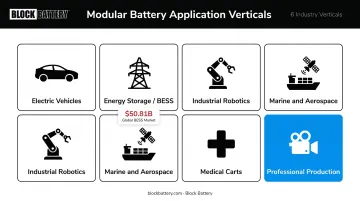
Of these verticals, professional production puts some of the sharpest pressure on modular battery design — because when a take is lost to a dead battery, there's no recovering it.
Professional Production: The High-Stakes Case
A feature film shooting day can run $50,000–$200,000+ in crew and equipment costs. Power failure isn't a technical inconvenience — it's a budget line item.
Camera body power draws alone span a wide range across professional cinema cameras:
| Camera | Typical Power Draw |
|---|---|
| ARRI ALEXA 35 | 85–135W (recording, with MVF-2) |
| ARRI ALEXA Mini LF | ~69W |
| Sony VENICE 2 (8.6K) | ~76W |
| RED V-RAPTOR | 60–75W |
| Phantom Flex4K with CineMag | ~140W |
Add monitors, wireless follow focus, lens motors, and on-camera accessories, and peak system draws climb substantially above the camera-body figure. Sizing a modular battery system around nominal camera draw alone will leave a crew short.

That's the environment Block Battery was built for. With 30 years of management experience in the professional broadcast, video, and cinema battery space, their systems are designed around real production demands — not spec-sheet assumptions. Their lineup is stocked at rental houses including Keslow Camera, Panavision, ARRI Rental, and AbelCine. Linkey Block systems are purpose-built for sustained Phantom high-speed recording sessions, helicopter rigs, and video village setups where a mid-take battery swap isn't an option.
What to Look for When Choosing a Modular Battery
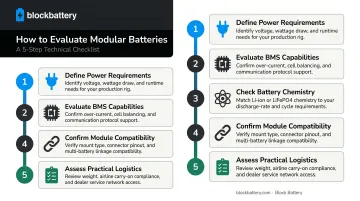
When evaluating modular systems for professional production use, work through these dimensions in order:
1. Define your power requirements first
- What is the peak draw of every device in the rig (camera + accessories + lighting)?
- How many hours of runtime are needed per charge cycle?
- What voltage rails do your cameras and devices require?
2. Evaluate BMS capabilities
- Does the BMS monitor per module, or only at the pack level?
- What protections are included: overcharge, over-discharge, over-temperature, overcurrent?
- Does it support fault detection and diagnostics?
3. Check chemistry for the application
- LiFePO4 (LFP) offers strong thermal stability (linked to its olivine structure and P-O covalent bonds) and cycle life exceeding 2,000 cycles in comparative testing — well-suited for demanding production environments
- Li-ion (NMC) offers higher energy density at roughly 3.8V per cell vs. LFP's ~3.4V, which can matter where weight and volume are constrained
4. Confirm module compatibility requirements
- All modules in a linked system must match manufacturer specifications — voltage, capacity, and chemistry
- Mixing brands or series creates both safety and performance risks; there is no reliable way to verify BMS compatibility across manufacturers
5. Assess practical logistics
- Is hot-swap capability needed for continuous-operation environments?
- Are the modules under 100Wh per unit for airline carry-on compliance? (FAA/IATA allow lithium-ion batteries up to 100Wh in carry-on; spare batteries in the 101–160Wh range require airline approval)
- Does the system retain the same mounting interface across configurations?
If you're evaluating Block Battery's lineup against those criteria, three products cover most production scenarios:
- Artisan Block — mixed-voltage camera packages requiring capacity scalability
- Linkey Block — extended runtime in lighting, aerial, and video village applications
- Protean 4 — simplified 14V/28V dual-voltage coverage across mixed camera rigs
Frequently Asked Questions
What is a modular battery?
A modular battery is a battery pack engineered to connect with other identical packs in series or parallel, allowing users to scale voltage or runtime without replacing the entire system. The design enables incremental expansion, isolated module replacement, and flexible power configurations across different applications.
Are modular batteries rechargeable?
Yes. Modular batteries use rechargeable lithium-based chemistries — most commonly LiFePO4 or Li-ion — that support hundreds to thousands of charge-discharge cycles. Each module charges independently through standard charging infrastructure, unaffected by the modular design.
How do modular batteries connect — in series or parallel?
Both options are available, depending on what the application needs. Series connections stack voltage while keeping capacity constant. Parallel connections increase runtime (amp-hours) while holding voltage steady. Combined series-parallel configurations achieve both simultaneously.
What is the difference between a modular battery and a standard battery pack?
A standard battery pack has fixed capacity — when it fails or runs short, the entire unit is the problem. A modular battery lets you swap out a single failed module or add capacity incrementally, without touching the rest of the system.
Are modular batteries suitable for professional video and cinema production?
They're particularly well-suited for it. Variable power demands, long shooting days, mixed-voltage camera packages, and the cost of on-set downtime all make scalability and fast module replacement essential. Block Battery builds purpose-built modular systems for these environments — from feature film rigs and aerial cinematography to lighting and video village setups.