Introduction
On a feature film set, power is infrastructure. An ARRI Alexa 35 draws between 85 and 135 watts while recording — and that's just the camera body. Add a lighting rig, sound cart, and video village, and the power demands compound fast. When a battery takes four hours to recharge and production has a 30-minute window, the math doesn't work.
Fast-charging lithium-ion technology promises shorter turnaround times, but the chemistry underneath that promise is more complicated than the watt-hours on the label suggest. Charging too aggressively degrades cells faster, generates dangerous heat, and — in worst-case scenarios — creates safety risks that no production schedule is worth.
This article breaks down the fundamental science governing how fast a lithium-ion battery can charge, the four key variables that define real-world limits, and what current research is unlocking about pushing those limits further without sacrificing cycle life — so production professionals can make smarter decisions about equipment that has to perform across 200 shooting days.
Key Takeaways:
- Charging speed is limited by ion-electron transfer kinetics at the electrode interface, not just charger wattage
- C-rate, temperature, electrolyte composition, and charge voltage ceiling are the four variables that control fast-charging performance
- Charging too fast accelerates lithium plating, SEI layer growth, and capacity fade
- MIT's 2025 CIET research and Chung-Ang University's electrolyte work point toward faster, safer charging without sacrificing cycle life
- Partial charging and active temperature management are actionable techniques available now
How Lithium-Ion Batteries Actually Charge
The Intercalation Mechanism
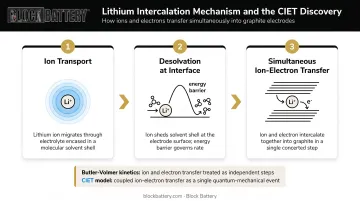
Every charge cycle moves lithium ions from the positive electrode, through the electrolyte, and into the negative electrode — typically graphite. This process is called lithium intercalation: the ions insert themselves into the layered structure of the electrode material. It's reversible, happening thousands of times over a battery's life.
Two components set the speed limit for this process:
- The electrolyte — the medium lithium ions travel through, which also determines how easily they shed their solvent shell before entering the electrode
- The electrode material — the host that receives ions, which has its own structural and kinetic constraints on how fast intercalation can occur
Each component introduces distinct, measurable resistance — and both must be optimized to meaningfully increase charge speed.
The Old Model vs. The New Understanding
Understanding those bottlenecks required a reliable model — and for decades, researchers turned to the Butler-Volmer equation, a nearly century-old electrochemical framework. The problem: real-world measurements never matched its predictions consistently, with reported intercalation rates varying by factors of 10x to 1,000x across different labs.
In October 2025, MIT researchers published a landmark paper in Science identifying why. Lithium intercalation is governed by coupled ion-electron transfer (CIET) — meaning a lithium ion and an electron must transfer simultaneously at the electrode surface. This quantum-mechanical mechanism lowers the energy barrier for the reaction. It also predicts that current density increases linearly with lithium vacancy fraction — a relationship Butler-Volmer cannot explain.
The research team validated this framework across eight electrode materials and hundreds of data points. The practical value: battery designers now have a rational, theory-based formula to identify which material parameters to adjust, rather than relying on trial and error. As MIT News described it, the finding could guide the design of faster-charging, longer-lasting batteries from first principles.
Key Variables That Control Fast-Charging Speed
Four variables determine how quickly a lithium-ion battery can accept a charge. For production professionals managing battery fleets across demanding shoot schedules, understanding each one is the difference between informed purchasing and expensive surprises.
C-Rate: The Speed Dial of Charging
C-rate is the ratio of charge current to battery capacity. At 1C, a battery charges fully in one hour. At 2C, in 30 minutes. At 0.5C, two hours.
Battery University's guidance on charging lithium-ion cells is direct on this: energy cells are commonly charged at 0.5C to 1C, with manufacturers recommending 0.8C or less to prolong life. Purpose-built power cells tolerate higher rates with less stress. Most professional production batteries — even high-capacity ones — aren't optimized for ultra-high charge rates the way dedicated power cells are.
Higher C-rates produce:
- More heat generation per unit time
- Greater mechanical stress on electrode materials
- Elevated risk of lithium plating at the anode (covered below)
Temperature: The Silent Performance Variable
Temperature affects charging in both directions, and both extremes cause damage.
According to Battery University's temperature data:
| Condition | Temperature Range | Effect |
|---|---|---|
| Permissible charge range | 0°C to 45°C | Safe operation |
| Fast charge window | 5°C to 45°C | Reduced risk |
| Optimal charge | 10°C to 30°C | Best performance |
| Below 0°C | No charging | Lithium plating risk |
Elevated temperatures accelerate the intercalation reaction and reduce electrolyte resistance — speeding things up. But the cost is faster permanent capacity loss. After one year of storage at 40°C with a full charge, a lithium-ion cell retains roughly 65% of its original capacity. At 25°C, that figure is 80%.
Cold temperatures are equally problematic — slower ion movement and the real risk of metallic lithium depositing on the anode rather than intercalating cleanly.
Electrolyte Composition: The Ion Highway
The electrolyte doesn't just transport lithium ions. It's the medium through which ions must shed their solvent shell before entering the electrode. This desolvation step carries a measurable energy barrier, and it's a significant contributor to charging speed limits.
Research from Chung-Ang University, published in Energy Storage Materials, demonstrated that electrolyte formulation is a powerful lever. Using a high-concentration 3M LiPF6 electrolyte in dimethyl carbonate with 5 wt% FEC in graphite/NMC622 full cells, the team showed that concentrated linear-carbonate electrolytes lower the desolvation barrier, enhance interface kinetics, and improve fast-charging performance without causing lithium plating or cell swelling.
In other words, a battery's maximum charge rate is shaped as much by what's inside the cell as by what the charger outputs.
Electrode Material and Charge Voltage Ceiling
The electrode host material determines how much lithium it can absorb and how fast. NMC, LFP, and graphite all have different rate capabilities and structural tolerances.
Charge voltage ceiling directly controls both stored capacity and longevity. Most lithium-ion cells charge to 4.20V/cell maximum. Battery University's data on the voltage-life trade-off is concrete:
| Peak Charge Voltage | Estimated Cycle Life | Stored Energy |
|---|---|---|
| 4.20V/cell | 300–500 cycles | 100% |
| 4.06V/cell | 600–1,000 cycles | 81% |
| 4.00V/cell | 850–1,500 cycles | 73% |
| 3.92V/cell | 1,200–2,000 cycles | 65% |
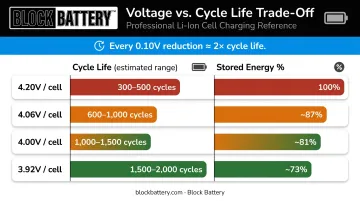
Every 0.10V/cell reduction in peak charge voltage is associated with approximately doubled cycle life, at the cost of reduced stored capacity. For professionals managing battery fleets across hundreds of production days, this trade-off is a genuine engineering decision, not just a spec sheet footnote.
The Hidden Cost of Charging Too Fast
Lithium Plating: The Fast-Charging Risk
When charge current exceeds what the graphite anode can absorb through intercalation, lithium ions deposit as metallic lithium on the electrode surface instead of inserting cleanly into it. This is lithium plating.
Metallic lithium can form dendrites, needle-like structures that grow toward the separator and, in severe cases, pierce it. A compromised separator creates a direct internal short circuit pathway — the precondition for thermal runaway.
Research published in ACS Applied Materials & Interfaces confirmed that plated lithium after fast charging can trigger earlier thermal runaway. Fast-charging safety is a cell integrity issue, not just a capacity concern.
Capacity Fade and Internal Resistance
Aggressive charging accelerates growth of the solid-electrolyte interphase (SEI) layer on the anode — a film that forms as electrolyte decomposes at the electrode surface. SEI growth:
- Consumes active lithium inventory (reducing capacity)
- Increases internal resistance over time
- Creates pore clogging in the electrode structure
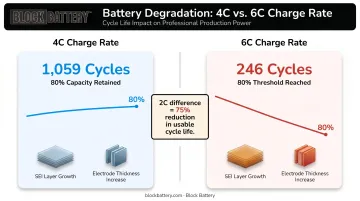
A 2025 study of commercial LiFePO4/graphite cells quantified this starkly: cells cycled at 4C retained 80% capacity after 1,059 cycles. Cells cycled at 6C reached that same degradation threshold in just 246 cycles. SEI thickness exceeded 1 micron at the center of 4C anodes, and electrode thickness increased by 52%. That 2C rate difference cut usable cycle life by more than 75% — a significant factor when managing battery fleets across a production season.
The Depth-of-Discharge Connection
SEI growth and capacity fade don't happen in isolation. Fast charging in production environments typically pairs with deep discharges, running batteries close to empty before recharging, which stacks additional electrode stress on top of the chemistry damage already accumulating.
Battery University's DoD data illustrates the cycle life impact:
- 100% DoD: ~300 cycles (NMC), ~600 cycles (LFP)
- 40% DoD: ~1,000 cycles (NMC), ~3,000 cycles (LFP)
- 20% DoD: ~2,000 cycles (NMC), ~9,000 cycles (LFP)
Shallower discharge cycles reduce electrode stress and compound gains with better charge rate discipline. For production crews running high-capacity packs across multi-day shoots, keeping DoD in the 40–60% range is one of the highest-return operational adjustments available.
What Current Research Is Unlocking
Two research threads are advancing fast-charging science at the same time, and their findings are starting to converge.
MIT's CIET framework gives materials designers a validated model for how ion-electron transfer governs intercalation kinetics. The practical value isn't just academic. It identifies which electrode and electrolyte properties to modify to reduce side reactions and degradation at higher charge rates. MIT researchers are also testing more than 50 electrolyte and electrode combinations to build machine-learning models for next-generation electrolyte discovery — connecting theory directly to materials screening.
Chung-Ang University's electrolyte optimization work showed that electrolyte engineering — independent of electrode design changes — can meaningfully improve fast-charging performance. For production battery design, that matters: improvements don't require entirely new electrode architectures. Better electrolyte formulations, applied to existing cell geometries, can raise the fast-charging performance ceiling.
Together, these two directions point toward a future where faster charging doesn't automatically mean shorter pack life. The research isn't there yet for production packs — but the theoretical and materials foundations being built now are what make that outcome possible.
What This Means for Professional Production Batteries
The variables researchers are studying — charge rate, temperature management, electrolyte quality, and voltage ceiling — are the same variables that determine whether a battery fleet survives a 200-day feature production or needs mid-project replacement.
An ARRI Alexa 35 draws 85–135W while recording. A Sony VENICE 2 draws approximately 76W under typical recording conditions. Add lighting rigs, a sound cart, and video village infrastructure, and a production's total power demand can run into the kilowatts. Batteries in this environment face sustained high-current discharge, repeated charge cycles, and variable ambient temperatures — exactly the conditions where these degradation mechanisms compound fastest.
Block Battery designs its product lineup around the power demands of professional production, not consumer use cycles. The range runs from the compact 2F1-150 for ENG run-and-gun applications through the INDY 3000/5000/6000 for sustained lighting production.
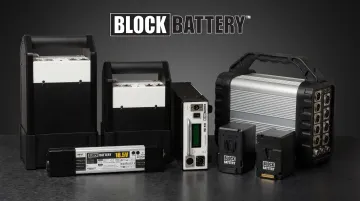
Products like the SLi-D600 and SLi-D1000 are built specifically for sustained high-current draw. The modular Linkey Block system addresses the short-turnaround problem by eliminating mid-take swaps entirely.
Practical guidance for production professionals:
- Avoid charging at temperature extremes — keep batteries within the 10°C–30°C optimal window when possible
- Don't routinely charge to 100% when the shoot doesn't require full capacity — partial charging reduces electrode stress and extends cycle life
- Avoid deep discharges when partial cycles are operationally feasible
- Prioritize batteries from manufacturers who understand the specific sustained-current and duty-cycle demands of professional production
- For fleet operations, consider tools like battery analyzers that enable proactive cell balancing and health assessment before degradation becomes a field problem
Understanding C-rate, temperature limits, and voltage management translates directly into smarter battery decisions on set — and fewer surprises during a 200-day shoot.
Frequently Asked Questions
What is the main limiting factor in fast-charging a lithium-ion battery?
The primary limits are the rate of lithium-ion desolvation and intercalation at the electrode-electrolyte interface, internal resistance, and heat generation. MIT's 2025 CIET research identified that ion-electron transfer kinetics at the electrode surface is a foundational bottleneck — meaning faster charging requires addressing interface chemistry, not just increasing charger output.
Does fast charging damage lithium-ion batteries?
Fast charging accelerates wear through heat generation, lithium plating risk, and SEI layer growth — but severity depends on how aggressively the cell is charged relative to its design specs. Appropriate electrolytes, thermal management, and BMS design can significantly limit these effects.
What is lithium plating and why is it a concern?
Lithium plating happens when charge current exceeds what the graphite anode can absorb, causing lithium ions to deposit as metallic lithium on the electrode surface instead of intercalating normally. The resulting dendrites can pierce the separator, creating short-circuit conditions and thermal runaway risk — especially at ultra-fast charge rates.
What is C-rate and how does it relate to charging speed?
C-rate expresses charge current relative to battery capacity: 1C delivers a full charge in one hour, 2C in 30 minutes. Higher C-rates charge faster but generate more heat and place greater electrochemical stress on the cell. Battery manufacturers generally recommend 0.8C or below for energy cells to preserve cycle life.
How does temperature affect lithium-ion fast-charging performance?
Moderate warmth (10°C–30°C) aids ion mobility and speeds charging. Below 5°C, current should be reduced; below 0°C, charging should stop entirely to prevent lithium plating. Above 45°C, charging accelerates capacity degradation and falls outside safe operating limits.
What recent research is advancing fast-charging battery technology?
MIT's 2025 CIET model (Science) offers a validated framework for designing electrode-electrolyte interfaces that support faster, more controlled charging. Separately, Chung-Ang University's research (Energy Storage Materials) showed that concentrated LiPF6 electrolyte formulations improve fast-charging kinetics without sacrificing cycle life — confirming that electrolyte engineering matters as much as electrode design.