Introduction
A 600Wh rating on a professional lithium battery is a precise measure of stored energy — one of the most misunderstood specifications in professional production. It tells you exactly how long your equipment runs before requiring a recharge. But only if you know how to read it correctly.
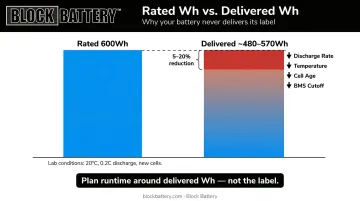
Many cinematographers and production coordinators treat 600Wh as a guaranteed runtime figure. It is not. It is a rated capacity measured under standardized laboratory conditions, and real-world delivery consistently falls short of that number due to discharge rate, temperature, cell age, and battery management system cutoffs.
This guide covers the key variables that determine whether your 600Wh battery actually delivers on set:
- What 600Wh means electrically — and what it doesn't guarantee
- How different voltage architectures produce the same watt-hour rating
- Which field conditions erode delivered energy and by how much
- The airline carry-on limits that catch productions off guard
Key Takeaways
- 600Wh = Voltage × Amp-hours — a 14.8V battery at ~40.5Ah yields 600Wh; a 24V battery at 25Ah yields the same
- Expect less than 600Wh in practice — load, temperature, age, and BMS cutoff all reduce delivered energy
- Runtime estimate: divide 600Wh by your load in watts, then apply an 80–85% real-world factor
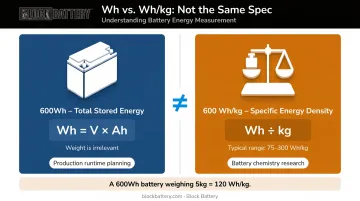
- Don't confuse 600Wh (total stored energy) with 600 Wh/kg (specific energy density) — they measure different things
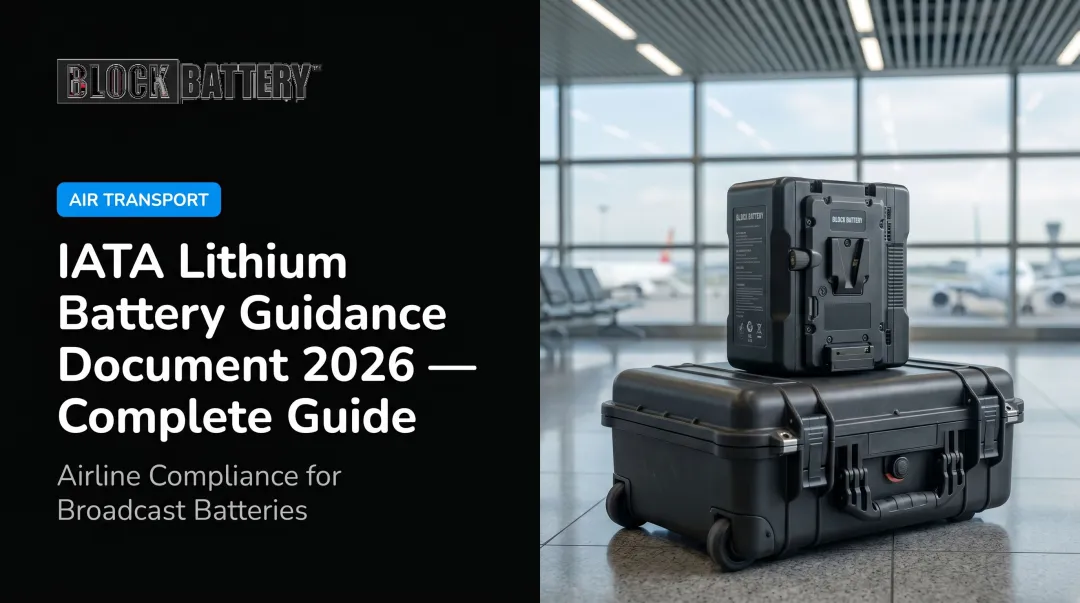
- IATA caps carry-on spare batteries at 160Wh — a 600Wh pack requires airline authorization and ships as air cargo
What 600Wh Means as a Battery Specification
The Definition and the Formula
A watt-hour is a unit of energy: the ability to deliver one watt of power continuously for one hour. A 600Wh battery can theoretically supply 600W for one hour, or 60W for ten hours — the relationship between power and time scales linearly under ideal conditions.
That relationship follows a single formula:
Wh = Voltage (V) × Amp-hours (Ah)
As IATA's lithium battery guidance defines it, a battery's watt-hour rating equals its rated capacity in Ah multiplied by its nominal voltage — and the FAA uses the same formula for passenger battery compliance checks.
Same Wh, Different Configurations
The same 600Wh rating can correspond to very different physical battery configurations:
| Nominal Voltage | Required Ah | Result |
|---|---|---|
| 14.8V | ~40.5Ah | ≈600Wh |
| 24V | 25Ah | 600Wh |
| 28.8V | ~20.8Ah | ≈600Wh |
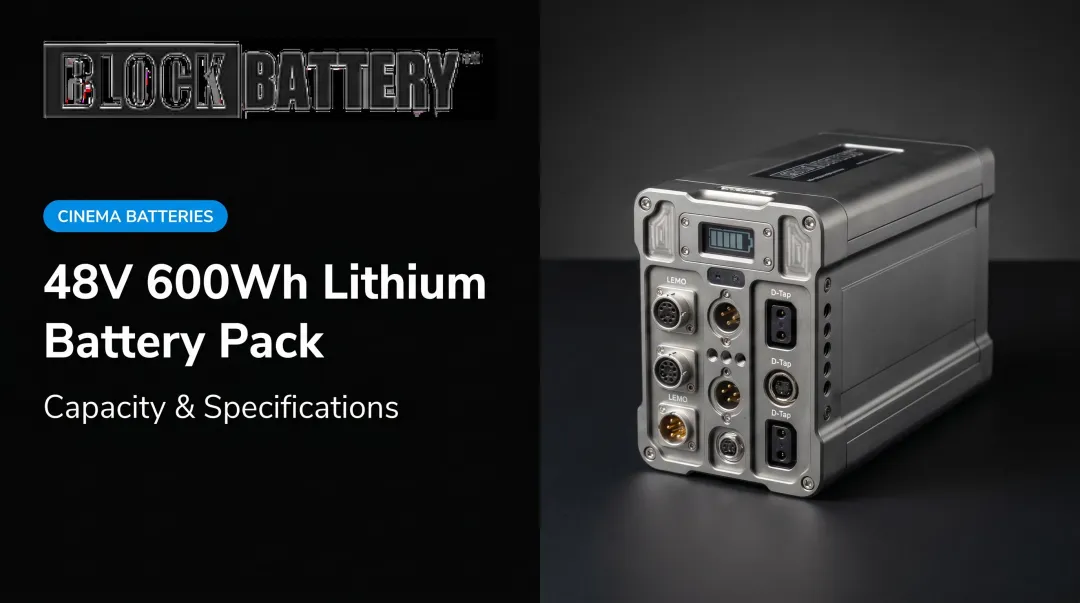
Block Battery's SLi-600, SLi-HC600, and SLi-D600 all support multi-voltage output — 14.4V, 24V, 28.8V, and 30V — covering the power rails of ARRI Alexa, Sony Venice, RED V-Raptor, and Phantom high-speed camera systems. Voltage selection changes how many Ah are required to hit 600Wh, but the total stored energy stays fixed regardless of which rail you're running.
600Wh vs. 600 Wh/kg — A Critical Distinction
It's easy to confuse two entirely separate specifications that share similar notation:
- 600Wh = total stored energy capacity (how much energy the battery holds, regardless of weight)
- 600 Wh/kg = specific energy density (how much energy per kilogram of battery mass — a chemistry research metric)
Current production lithium-ion cells typically fall in the 75–300 Wh/kg range depending on chemistry and design. A production battery rated at 600Wh might weigh around 5kg, giving it an energy density near 120 Wh/kg. These are unrelated numbers serving unrelated purposes — conflating them leads to spec errors when selecting batteries for production.
Factors That Influence Real-World Delivery of the Rated 600Wh
The 600Wh nameplate is a standardized laboratory measurement, not a field delivery guarantee. IEC 61960-3:2017 rates lithium cells at 20°C ±5°C under a controlled 0.2C discharge rate. Production environments rarely match those conditions.
Discharge Rate
Higher current draws produce more internal resistance losses, reducing total delivered energy. This is the Peukert effect. Lithium-ion cells have a much smaller Peukert exponent than lead-acid batteries (approximately 1.05 for lithium-ion vs. significantly higher for lead-acid), but the effect is real. Running a 600Wh battery at a heavy continuous load will yield less usable energy than running it at a moderate load.
For productions powering high-wattage lighting fixtures alongside a camera, the combined load compresses runtime more than the arithmetic suggests.
Temperature
Cold environments reduce battery capacity. Molicel's P26A cell datasheet (a representative professional-grade 18650 cell) shows roughly 17% capacity loss at 0°C and about 29% loss at -20°C compared to rated output at standard temperature.
These are cell-level figures and vary by chemistry. The direction, though, is consistent: the colder the shoot, the less usable energy your 600Wh pack actually delivers.
Cell Ageing and State of Health
Lithium cells lose capacity over charge/discharge cycles. Cell-level data shows approximately 88% capacity retention at 300 cycles and 80–82% at 500 cycles for high-performance cells — though cycle life figures are protocol-specific and vary by discharge rate, temperature, and depth of discharge. A battery that nominally rated 600Wh at the start of its service life may effectively be a 480–500Wh battery after several hundred deep cycles.
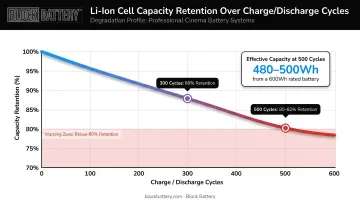
For rental house fleet managers and owner-operators running older packs, building a 15–20% capacity buffer into runtime calculations is a practical baseline.
BMS Depth of Discharge Limits
Most professional battery management systems reserve a portion of the cell range to protect longevity. The BMS prevents discharge below a defined cutoff voltage, meaning the accessible energy is less than the full rated 600Wh. That reserved margin is typically 5–10% of rated capacity, depending on the pack's design. Check the specific product documentation for the cutoff voltage of the battery you're running.
Key Technical Properties of a 600Wh Lithium Battery
600Wh describes energy capacity. It does not describe how quickly that energy can be delivered, how the battery behaves across its discharge curve, or how fast it can be safely recharged. These interdependent specifications determine whether a battery actually works in a given application.
Voltage Stability and Discharge Curve
Lithium cell voltage is not fixed — it starts near 4.2V per cell at full charge, sits around 3.6–3.7V nominal, and drops to approximately 3.0V at end of discharge. The nominal voltage used in the Wh calculation is a weighted average across this curve, not a fixed operating voltage.
Equipment that requires a minimum operating voltage may shut down or underperform before the battery's BMS cutoff is reached. For cameras like the ARRI Alexa 35 or Sony Venice 2 with specific power rail requirements, this makes voltage stability across the discharge curve a real operational concern — not just a spec-sheet detail.
Voltage behavior is only part of the picture. Current delivery is an equally critical constraint — and one that catches many buyers off guard.
Continuous vs. Peak Discharge Current
Energy capacity (Wh) and current delivery capability (amps) are separate specifications that must both match the application. A 600Wh battery with a 10A continuous rating cannot safely power a 1,000W load at 28.8V (~34.7A) regardless of how much energy it stores.
Professional cinema cameras have defined continuous and peak power demands:
| Camera | Published Power Draw |
|---|---|
| ARRI ALEXA 35 | ~90W (body + MVF-2) |
| Sony VENICE 2 | ~76W nominal, ~100W maximum |
| RED V-RAPTOR 8K | 60W basic, 75W maximum |
Accessories stack on top: a SmallHD Cine 7 monitor adds up to ~34W, an ARRI cforce mini lens motor adds up to 20W peak, and a Teradek Bolt 6 wireless transmitter adds ~9W. A complete camera package can easily reach 150–200W continuous before any lighting load is added.
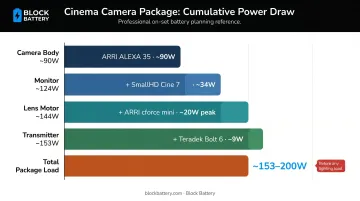
That sustained current demand — not raw capacity — is the real design constraint. Block Battery's SLi-600 and SLi-HC600 are built specifically for these high-current applications: lighting production, gimbal systems, and aerial cinematography rigs where a battery's amp delivery rating matters as much as its Wh figure.
Charge Rate and Thermal Coupling
C-rate describes charge or discharge current relative to capacity. A 1C charge rate on a 600Wh battery at 14.4V nominal (~41.7Ah) means charging at ~41.7A. Charging above approximately 1.5C accelerates three failure mechanisms — particularly at low temperatures:
- Heat generation that stresses cell chemistry and degrades insulation
- Lithium plating on the anode, which permanently reduces usable capacity
- Capacity fade that compounds across charge cycles
The practical trade-off is straightforward: faster charging shortens battery lifespan. Block Battery's DFC Charger and PSU-185 are designed to balance charge speed against thermal load and cycle longevity — because pushing charge rate for speed on set is a short-term gain with a long-term cost.
How a 600Wh Battery Is Specified, Measured, and Verified
What a Proper Datasheet Should Contain
A complete specification for a 600Wh professional battery should include:
- Rated energy (Wh) — under defined test conditions
- Nominal voltage — the voltage basis for the Wh calculation
- Amp-hour capacity — at the defined test discharge rate
- Maximum continuous discharge current — the sustained current limit
- Charge voltage limits — maximum charge voltage per cell and per pack
- Operating temperature range — both charge and discharge
- Cycle life — at a defined depth of discharge and temperature
- BMS protection parameters — over-discharge cutoff, overcurrent threshold, thermal protection
Missing any of these figures forces guesswork on set. A battery without a published continuous discharge current rating, for example, can't be reliably matched to high-draw loads like HMI ballasts or large-format cinema cameras. Knowing what's on the datasheet also sets up the next question: where does that rated Wh number actually come from?
How Wh Is Actually Measured
NIST's framework for power and energy measurement defines electrical energy as integrated power over time. Battery test equipment — systems like Neware or Arbin — records voltage and current continuously during a discharge, then integrates the product (V × A × time) to report watt-hours delivered.
This means:
- Rated Wh = what the manufacturer measured at controlled temperature, controlled current, and defined cutoff voltage
- Delivered Wh = what your equipment actually receives at your load, your temperature, your battery age, and your cable losses
The two figures will not match. In field conditions — cold exteriors, high-draw lighting rigs, aging cells — delivered energy typically runs 5–20% below the rated spec. Plan runtime around delivered Wh, not the label.
Risks of Exceeding or Underutilizing a 600Wh Battery
Over-Discharge
Discharging a lithium battery below its minimum cell voltage causes permanent damage. At extreme depths of over-discharge, copper dissolution from current collectors can occur inside the cell, a failure mode that degrades internal structure irreversibly. The BMS over-discharge cutoff exists specifically to prevent this.
Repeated discharge to the BMS cutoff limit (even within the protection boundary) accelerates capacity fade faster than shallower cycles.
Thermal Runaway
UL Research Institutes defines thermal runaway as an uncontrollable self-heating state in a lithium-ion cell. Triggers include:
- Sustained current draws above the rated limit (heat buildup from internal resistance)
- Physical damage or internal short circuit
- Overcharging beyond specified voltage limits
- Operating outside temperature range
The FAA notes thermal runaway can produce very high temperatures, venting, smoke, and fire. In professional batteries, BMS overcurrent cutoff and thermal protection are non-negotiable safety features, not optional additions.
Storage Degradation
Storing lithium batteries at very high or very low state of charge accelerates calendar aging. A Journal of the Electrochemical Society calendar-aging study found that storage SoC effects are chemistry-dependent and more nuanced than a simple "store at 50%" rule. The optimal storage SoC varies by cell chemistry.
For specific storage recommendations for Block Battery's SLi-600-class batteries, consult Block Battery directly or refer to product documentation from an authorized dealer.
Common Misconceptions About 600Wh Lithium Batteries
Four misconceptions come up repeatedly when production teams spec or travel with 600Wh batteries. Getting these wrong can mean blown schedules, undersized gear, or seized shipments at the airport.
The 600Wh figure guarantees runtime. It doesn't. That number reflects a best-case, standardized-condition measurement. For professional scheduling, apply a planning factor of 80–85% of rated Wh to account for temperature, load rate, and cell age. A 100W camera draw doesn't yield 6 hours — expect approximately 4.8 to 5 hours under realistic field conditions.
600Wh and 600Ah are the same thing. They're not even close. A 600Ah battery at 12V stores 7,200Wh — roughly 12 times the energy of a 600Wh pack. Search "600Ah lithium battery" and you get large-format marine or solar storage systems. Search "600Wh lithium battery" and you get professional portable power packs. The two terms describe different quantities serving different markets.
High capacity means high-power capability. Capacity (Wh) and current output (A) are independent specs. A 600Wh battery with a 10A continuous rating cannot power a 1,000W load — no matter how much energy it stores. Always verify both energy capacity and continuous current rating against your application before selecting a battery.
The airline threshold for spare batteries is 300Wh. The correct IATA passenger threshold is 160Wh, not 300Wh. Here's how the tiers break down:
- Up to 100Wh: Permitted in carry-on without airline approval
- 101Wh–160Wh: Permitted with airline/operator approval; limited to two spares in carry-on
- Above 160Wh: Must travel as cargo under IATA Dangerous Goods Regulations
The 300Wh threshold applies specifically to mobility aids — not professional camera spares. A 600Wh production battery exceeds the standard passenger spare limit and requires specific airline authorization before travel.
Frequently Asked Questions
How long does a 600Wh battery last?
Divide 600Wh by your load in watts for a theoretical maximum, then multiply by 0.80–0.85 for real-world conditions. A 100W camera load yields approximately 4.8 to 5 hours; a 200W combined camera-and-monitor load yields roughly 2.4 to 2.5 hours. Cold weather and aged cells reduce those estimates further.
How much is a 600Ah lithium battery?
A 600Ah battery is not the same as a 600Wh battery — at 12V, a 600Ah pack stores 7,200Wh, a completely different product category. A 600Wh professional production battery is a portable cinema pack; pricing varies by voltage configuration, mount type, BMS quality, and manufacturer.
What voltage is a 600Wh lithium battery?
600Wh batteries are available in multiple voltage configurations. Common options include 14.4V (~41.7Ah), 24V (~25Ah), and 28.8V (~20.8Ah). Block Battery's SLi-600-class batteries support 14.4V, 24V, 28.8V, and 30V multi-voltage output, with voltage selection determined by the camera or fixture being powered.
Can I take a 600Wh lithium battery on a plane?
No — not as a standard carry-on spare. IATA limits spare lithium-ion batteries to 160Wh maximum; anything above that requires air cargo handling under Dangerous Goods Regulations. A 600Wh battery requires specific airline authorization — confirm with your carrier and check current IATA or FAA guidelines before travel.
What is the difference between 600Wh and 600 Wh/kg?
600Wh is total stored energy — how much energy the battery holds regardless of its weight. 600 Wh/kg is specific energy density — how much energy per kilogram of battery mass, used in battery chemistry research. A 600Wh pack weighing 5kg has an energy density of 120 Wh/kg.
How do I calculate runtime for my equipment?
The formula: Runtime (hours) = Battery Wh ÷ Total Load (W) × 0.80–0.85. Sum all simultaneous loads before calculating — camera body, monitor, wireless video transmitter, and lens motor together, not just the camera alone. A camera drawing 90W, a monitor at 20W, and a wireless transmitter at 9W totals 119W; 600 ÷ 119 × 0.82 ≈ 4.1 hours under realistic conditions.