Manufacturers publish headline cycle counts, but those figures are measured under controlled lab conditions that rarely match real-world operation. The gap between rated and actual lifespan is governed by chemistry, depth of discharge, temperature, charge rate, and the quality of the Battery Management System (BMS) protecting the cells.
This guide unpacks what those numbers actually mean, what drives degradation, and how to evaluate what you're genuinely buying when a spec sheet claims 4,000 or 6,000 cycles.
Key Takeaways
- LiFePO4 batteries typically deliver 2,000–6,000+ charge cycles before capacity drops to 80% of original — roughly 5–15+ years under typical daily use
- Cycle life is conditional, not fixed — depth of discharge, temperature, C-rate, and cell quality all shift the actual number significantly
- Capacity fade is gradual and predictable; a well-maintained LiFePO4 battery does not simply stop working at its rated cycle count
- Published cycle figures assume controlled lab conditions: always apply a margin of safety in real applications
- Cell quality and BMS sophistication determine whether a battery actually reaches its rated cycle life
What LiFePO4 Cycle Life Really Means
The Technical Definition
"Cycle life" means the number of complete charge-discharge cycles a battery can complete before its usable capacity drops to a defined threshold — most commonly 80% of original rated capacity.
That 80% endpoint is the industry standard used by manufacturers including Victron and confirmed by the European Commission's Joint Research Centre (JRC, 2021) as the conventional battery end-of-life definition.
One full cycle is one complete transition from 100% state of charge down to 0% and back. Partial cycles — discharging to 50% and recharging — count as partial cycles proportionally.
Why LiFePO4 Outlasts Other Chemistries
The durability advantage comes down to crystal structure. Research by Wang and Sun (2015) confirms that LiFePO4's olivine structure contains strong phosphate-oxygen (P-O) covalent bonds that prevent oxygen release during cycling — the mechanism that causes thermal breakdown in competing chemistries.
In practice, this structural stability translates to meaningful performance differences:
- LiFePO4: Resists thermal runaway; maintains capacity under repeated high-current cycling
- NMC / NCA: Oxygen release during stress accelerates degradation and raises safety risk
- Result: LiFePO4 cells routinely outlast NMC equivalents by 2–3× in cycle count under comparable conditions
That chemistry advantage connects directly to how lifespan is actually measured — because there are two distinct dimensions to consider.
Cycle Life vs. Calendar Life
Lifespan has two distinct dimensions:
- Cycle life — total charge-discharge cycles before capacity degrades to 80%
- Calendar life — total years of service, accounting for storage aging, self-discharge, and passive degradation
A 2025 calendar-aging study published in Joule (Lam et al., 2025) analyzed LFP/graphite cells over periods up to 7.8 years, finding ambient-temperature calendar lifetimes in the range of 10 years for well-maintained cells. Calendar life is not a blanket guarantee — it depends heavily on storage temperature and state of charge.
How Long LiFePO4 Batteries Last: Lifespan Ranges
Nominal Lifespan Under Standard Conditions
Published cycle life figures vary significantly by cell grade and manufacturer. The table below shows verified, condition-disclosed ratings from major LiFePO4 cell manufacturers:
| Manufacturer / Model | Rated Cycle Life | Key Test Conditions |
|---|---|---|
| A123 ANR26650M1-B | >1,000 cycles | 100% DoD, 20A discharge, 23°C |
| EVE LF304 (304Ah) | ≥3,500 cycles | 1C/1C, 25°C, 80% EOL |
| EVE LF304 (304Ah) | ≥1,800 cycles | 1C/1C, 45°C, 80% EOL |
| Lithium Werks 26650M1B | 4,000 cycles | 100% DoD, 1C/1C, 25°C |
| Great Power IFR40135 | ≥4,000 cycles | 1C charge/discharge |
| CATL 280Ah LFP | 6,000 cycles | 80% DoD |
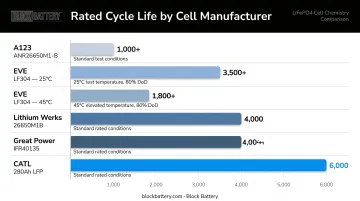
Standard-grade cells typically fall in the 2,000–4,000 cycle range; premium and EV-grade cells push 4,000–6,000+. At one cycle per day, that translates to roughly 5–11 years for standard cells, and 11–16+ years for premium cells under favorable conditions.
Allowable Operating Boundaries
These figures assume operation within defined limits. Key boundaries across major manufacturers:
- Charge temperature: 0°C to 60°C (EVE LF304); reduced current required below 0°C (Lithium Werks)
- Discharge temperature: -30°C to 60°C (EVE, Lithium Werks) — cold discharge tolerance does not mean cold charging is safe
- Maximum DoD for rated cycle life: 80–100% depending on manufacturer and application
- Voltage damage thresholds: Below 2.5V causes irreversible cell damage (Winston, EVE)
Safe Operating Margin
Experienced engineers and production professionals operate inside the boundary limits, not at them. Three practices make the difference between hitting rated cycle counts and falling short:
- Depth of discharge: Target 80% DoD rather than 100%
- Temperature: Keep cells in the 15–35°C range during operation and storage
- Charging hardware: Use a charger rated for LiFePO4 chemistry — not a generic lithium charger
Sustained operation at specification limits compounds degradation multiplicatively. Occasional limit excursions are manageable; running at the edge every cycle will measurably shorten the pack's service life before rated cycle counts are reached.
Key Factors That Govern LiFePO4 Battery Longevity
Lifespan is an output of how the battery is used, stored, and managed — not a passive attribute of the chemistry alone.
Depth of Discharge (DoD) and Cycle Life Trade-Off
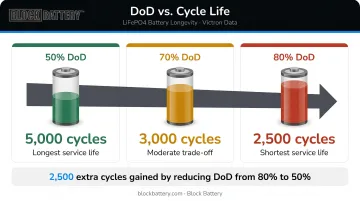
The relationship between DoD and cycle life is inverse and significant. Victron's published LiFePO4 data shows this clearly:
| Daily DoD | Cycle Life | Capacity Retention Endpoint |
|---|---|---|
| 50% DoD | 5,000 cycles | ≥80% nominal |
| 70% DoD | 3,000 cycles | ≥80% nominal |
| 80% DoD | 2,500 cycles | ≥80% nominal |
Moving from 80% to 50% daily DoD delivers 2,500 additional cycles — effectively doubling service life — with no hardware change. This is one of the highest-leverage decisions in battery system design.
Temperature: The Primary Degradation Accelerator
Elevated temperature accelerates electrolyte decomposition and solid electrolyte interphase (SEI) layer growth on the anode. The EVE LF304 datasheet makes this concrete: ≥3,500 cycles at 25°C vs. ≥1,800 cycles at 45°C — a reduction of nearly 50% from a 20°C temperature increase at the same 1C/1C charge-discharge rate.
Low temperatures create the opposite problem. Charging at low temperatures risks lithium plating on the anode — a 2018 study (Ruiz et al.) identified lithium plating via SEM analysis in aged LiFePO4/graphite cells subjected to low-temperature charge-discharge cycles. Lithium plating is permanent structural damage.
Charge and Discharge Rate (C-Rate)
C-rate describes how quickly a battery is charged or discharged relative to its capacity. A 1C rate charges or discharges the full capacity in one hour; a 2C rate does it in 30 minutes.
High C-rates generate excess heat and increase mechanical stress on the electrodes. A 2024 study of prismatic LiFePO4 cells (Roy et al.) found that increasing discharge rate from just 0.5C to 0.8C reduced cycle life by 52.9% at 25°C. Intermittent high-rate events are far less damaging than sustained operation at elevated C-rates.
Battery Quality, Cell Grade, and BMS Robustness
Cell chemistry consistency, electrode uniformity, and electrolyte purity directly determine how the battery retains capacity over cycles. A low-grade cell may degrade to 70% capacity in half the cycles of a premium equivalent — at the same nominal rating.
The BMS is equally critical. Accurate cell balancing, reliable low-voltage and high-voltage cutoffs, and effective thermal management determine whether rated limits are enforced or violated under real operating conditions. A capable BMS is the primary protection mechanism for cycle life — not a secondary feature.
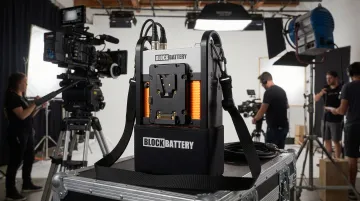
In high-draw production environments like cinema and broadcast, BMS precision matters beyond spec-sheet compliance. Systems built for professional V-Mount and Gold-Mount applications — such as Block Battery's SLi-series LiFePO4 packs — pair high-current cell configurations with BMS cutoffs calibrated specifically for the draw profiles of cameras like the ARRI Alexa and Sony Venice, where sustained high-current loads are routine rather than exceptional.
How LiFePO4 Lifespan Is Rated, Tested, and Verified
Reading Manufacturer Specifications
Not all cycle life ratings are created equal. When evaluating a datasheet, look for these specific disclosures:
- Rated cycle count — the headline number
- Depth of discharge at which the rating was measured (100% and 80% DoD yield very different results)
- Temperature during testing (25°C vs. 45°C is a nearly 2x difference for some cells)
- C-rate for charge and discharge (standard 0.5C vs. test-condition 1C affects the result)
- Capacity retention endpoint — confirmed as ≥80% capacity, or left unstated?
- Test standard referenced — IEC 62620 (industrial lithium batteries) and UL 1973 (stationary battery systems) are common frameworks
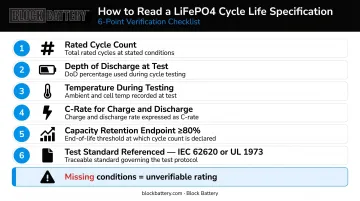
Some manufacturers publish optimistic figures without disclosing test conditions. If the DoD, temperature, and endpoint are not stated alongside the cycle count, treat that cycle count as unverifiable.
Field Measurement and Verification
Cycle life can be tracked in operation through:
- Battery capacity tester — measures actual mAh or Wh delivered under controlled conditions; compare against original rated capacity
- State-of-health (SoH) monitoring via the BMS — tracks capacity fade over time relative to baseline
- Internal resistance testing — rising internal resistance under load is a reliable early indicator of degradation, often detectable before significant capacity loss
For any of these methods to produce reliable data, test conditions must stay consistent across readings. A capacity measurement at 45°C tells you something different than one taken at 20°C — comparing the two will obscure real degradation trends rather than reveal them. Pairing datasheet specs with periodic field measurements gives the clearest picture of where a battery actually stands in its service life.
What Shortens LiFePO4 Battery Life: Common Mistakes
The most frequent mistake is treating the rated cycle count as a guarantee that holds regardless of operating conditions. It does not. Operating at 100% DoD every cycle, in elevated ambient temperatures, with an incompatible charger will produce far fewer usable cycles than the spec sheet number.
The most damaging operational patterns:
- Discharging consistently below BMS cutoff — irreversible capacity loss accumulates fast; EVE specifies a 2.5V cutoff, and Winston confirms damage below that threshold
- Charging at elevated rates in cold temperatures — lithium plating becomes a real risk below 0°C; Lithium Werks caps charge current at 250mA below that threshold for exactly this reason
- Running sustained cycles in high heat — EVE LF304 data shows that cycling at 45°C instead of 25°C cuts cycle life nearly in half
- Storing at full or empty charge for extended periods — EVE specifies 30–50% SOC for storage; at 100% or 0%, calendar aging sets in and no amount of operational discipline reverses it
Operational mistakes aside, how you select a battery in the first place creates its own problems. Choosing based on a 6,000-cycle headline without checking the test conditions is an easy trap. A battery rated for 6,000 cycles at 50% DoD and 25°C may deliver only 2,500 cycles running at 90% DoD in a warm equipment room. The spec is technically accurate — what it doesn't tell you is how it performs under your actual conditions.
Conclusion
LiFePO4 battery lifespan comes down to chemistry, operating conditions, and build quality — not just the number on the label. Knowing where those variables interact is what separates a well-sourced battery from an expensive field failure.
For broadcast, ENG, and professional cinema production — where a dead battery mid-take is not an option — getting to rated service life consistently requires a few non-negotiable practices:
- Operate within correct voltage and temperature margins
- Verify that manufacturer specs disclose the actual test conditions behind cycle-life claims
- Invest in cells paired with a robust BMS that enforces those margins automatically
Block Battery's LiFePO4-based systems, built on 20+ years of professional production experience, are engineered with those operating boundaries baked in — so the chemistry works as rated across the full lifespan of the battery.
Frequently Asked Questions
How long do lithium iron phosphate (LiFePO4) batteries last?
Most LiFePO4 batteries are rated for 2,000–6,000+ charge cycles before capacity drops to 80% of original, corresponding to roughly 5–15+ calendar years under daily cycling. Actual lifespan depends on depth of discharge, operating temperature, charge habits, and cell quality — so the real number varies meaningfully from the headline figure.
Is it safe to keep LiFePO4 batteries in the house?
LiFePO4 is among the safest lithium battery chemistries available. Its olivine crystal structure resists thermal runaway, making it suitable for indoor installation when housed in appropriate enclosures and operated within manufacturer-specified temperature and ventilation guidelines.
How does depth of discharge affect LiFePO4 battery cycle life?
Shallower discharges yield significantly more cycles. Victron's published LiFePO4 data shows 2,500 cycles at 80% DoD versus 5,000 cycles at 50% DoD — limiting daily discharge extends total service life without any hardware change.
What are the signs that a LiFePO4 battery is reaching end of life?
Three key indicators: measurable capacity fade (the battery stores and delivers noticeably less energy than when new), increased internal resistance (more heat under load, slower response), and shorter runtimes combined with longer charge times at the same usage patterns.
How do LiFePO4 batteries compare to lead-acid in terms of lifespan?
LiFePO4 batteries typically deliver 5–10 times more charge cycles than lead-acid equivalents. Victron's AGM data shows 400 cycles at 80% DoD versus 2,500+ cycles for LiFePO4 at the same depth — a longer service life that offsets the higher upfront cost over the battery's operational life.
Can you extend LiFePO4 battery life by not fully charging it every time?
Unlike some lithium chemistries, LiFePO4 does not require partial charging to stay healthy. Avoiding both 100% charge and 100% discharge within the same cycle does extend total cycle count, since reducing per-cycle stress accumulates measurable gains over years of use.