Power failure on location costs more than time. It costs trust, momentum, and sometimes the entire setup. Yet most crews treat battery planning as an afterthought — grabbing whatever's available rather than matching power to the actual job.
This guide covers what you need to know: the different types of portable battery packs for video lights, how to calculate runtime before you're on set, what features actually matter for professional use, and how to manage batteries safely across multi-day location work.
Key Takeaways
- V-mount batteries are the professional standard — consumer power banks lack the voltage and sustained output for video lights
- Calculate runtime using Battery Wh ÷ Light Wattage, then add buffer for real-world efficiency losses
- Batteries above 100Wh require airline approval; above 160Wh, they're banned from passenger carry-on
- D-tap, XLR 4-pin, and USB-C PD each have different power delivery limits — verify compatibility before purchasing
- Carry one spare charged battery per fixture and rotate oldest stock first
Types of Portable Battery Packs for Video Lights
Not all portable battery packs are built for video lights. The type that makes sense depends entirely on what fixture you're powering and what tier of production you're working on.
Compact Power Banks (USB-C / USB-A)
Consumer power banks work for low-wattage LED panels — think on-camera fill lights or small accent lights under 30W. For anything larger, they fall short.
The core limitation is voltage. USB Power Delivery profiles top out at 20V at 5A (100W) under standard PD specs. Professional fixtures like the Litepanels Gemini 2x1 Soft draw 325W and require 13–28V DC input; the Aputure LS 600d Pro draws up to 720W at 48V DC. A USB-C power bank can't touch either.
Use power banks for: on-camera LED fill lights, small ring lights, and interview accent lights when AC is unavailable. Don't rely on them for key lights.
V-Mount Batteries
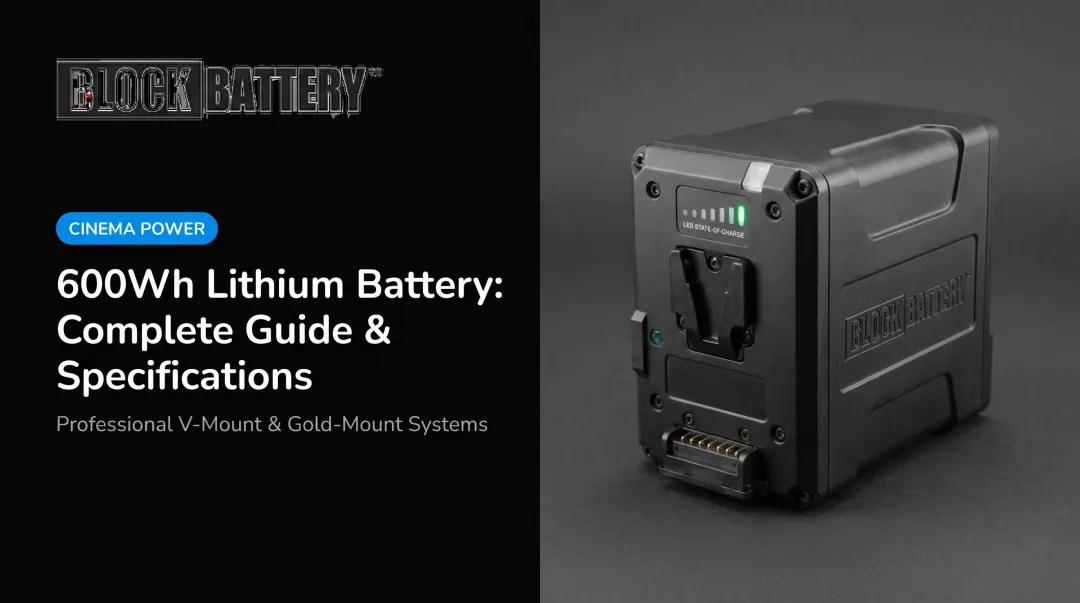
V-mount (V-lock) batteries are the professional cinema and broadcast standard. They deliver high sustained wattage through a standardized mounting system and are available in capacities ranging from roughly 95Wh to well beyond 300Wh — making them practical for powering fixtures from 100W LED panels up to large SkyPanel arrays.
According to SmallRig's V-mount battery guide, standard V-mount packs run at 14.4V nominal, with common capacities spanning 95Wh to 290Wh. Professional lighting-focused systems extend far beyond that range.
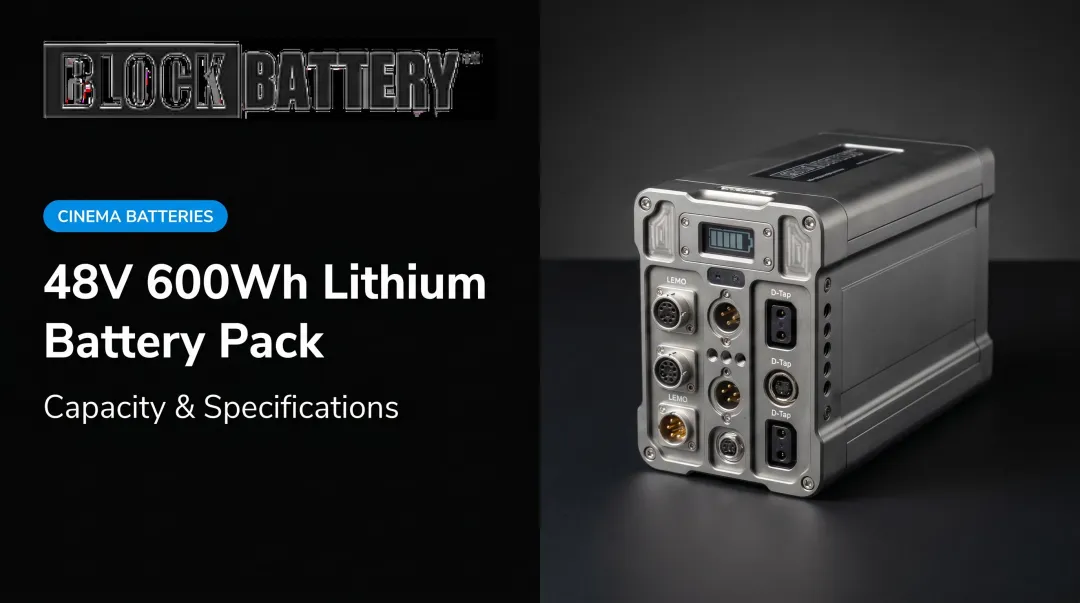
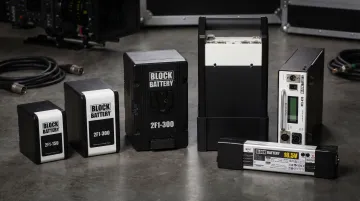
Block Battery, a veteran-owned American manufacturer with 30 years of industry experience, produces V-mount systems specifically engineered for lighting production. Their lineup spans from the 2F1-150 (150Wh) compact battery up through the INDY series at 3,000–6,000Wh.
The INDY series is designed for sustained operation of ARRI SkyPanel arrays, HMI fixtures, and large LED panel rigs on feature film sets — where runtime and output stability matter most.
Gold-Mount Batteries
Gold-mount (Anton Bauer-pattern) batteries are the competing standard, common in broadcast and ENG workflows. Functionally similar to V-mount in capacity and voltage, but physically incompatible — the mounting systems use different mechanisms and cannot be swapped directly. Most production teams standardize on one mount format. Block Battery manufactures Gold-Mount configurations across their full product lineup, from the 2F1-150 through the INDY series, giving productions the flexibility to stay within their existing mount system.
Power Stations (AC/DC Inverter Units)
Portable power stations — consumer units like Goal Zero or EcoFlow — are high-capacity, multi-outlet solutions capable of powering multiple lights simultaneously from a single unit. They're heavier and better suited to base-camp or semi-fixed setups than fast-moving shoots, but excellent where AC access is limited and the crew stays put.
Best for:
- Base-camp and semi-fixed location lighting rigs
- Multi-light setups requiring a single power source
- Situations where AC access is limited but portability is secondary
For professional production requiring DC-native output, purpose-built options avoid the energy losses of AC inverter conversion. Aputure's 2-Bay Battery Power Station, for example, converts two 14.4V batteries into regulated 48V DC at up to 480W — enough to run 300W LED fixtures at full output without the DC-to-AC-to-DC conversion penalty.
How to Match Battery Capacity to Your Video Lights
Capacity mismatch is the most common mistake location shooters make — either underpowering a fixture and causing flicker or unexpected shutdown, or carrying twice the battery weight they actually need.
Understanding Watt-Hours in Practice
A battery's Wh rating tells you how much total energy it stores. The basic runtime formula:
Runtime (hours) = Battery Wh ÷ Light Wattage
A 99Wh battery powering a 100W fixture gives you approximately 1 hour of runtime under ideal conditions. Real-world conditions reduce that — thermal losses, voltage sag under load, and partial dimming all affect actual output. Plan conservatively.
A practical example for a lighting package:
| Fixture | Power Draw | Battery (SLi-D600, 608Wh) | Estimated Runtime |
|---|---|---|---|
| 100W LED panel | 100W | 608Wh | ~6.1 hrs |
| 300W SkyPanel | 325W | 608Wh | ~1.87 hrs |
| 600W fixture | 600W | 608Wh | ~1 hr |
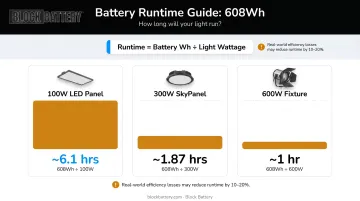
For heavier, longer-duration requirements, Block Battery's SLi-D1000 (970Wh) or the INDY 3000 (3,000Wh) extend runtime significantly for sustained fixture operation on multi-day shoots.
Accounting for Multiple Lights
On professional sets, multiple lights run simultaneously. Add total wattage across your lighting package, then divide into battery capacity to determine how many batteries you need per hour.
One important nuance: dimming a light to 50% does not always reduce power draw by 50%. LED fixture efficiency at various dimmer settings varies by manufacturer and model. Check the actual power draw specs in the fixture's documentation at each dimmer level before building your battery plan.
Planning a Full Shoot Day
The practical rule for production planning:
- Calculate theoretical runtime using Battery Wh ÷ Light Wattage
- Add a buffer for efficiency losses, charging downtime, and unexpected scenes
- Carry at least one spare fully-charged battery per fixture
For multi-day location shoots with demanding cinema lights, working with Block Battery's team helps. With 30 years of professional broadcast and cinema battery experience, they can help crews size packages correctly through their authorized dealer network — before gaps show up mid-production.
Key Features to Evaluate Before You Buy
Capacity alone doesn't make a battery pack right for location video lighting. Several other criteria determine whether a battery holds up on a professional set.
Output Voltage and Current Stability
Video lights are sensitive to voltage fluctuations. A battery that drops voltage under sustained load causes light flicker — particularly problematic when shooting at high frame rates. The ARRI SkyPanel user manual notes its High Speed mode was tested up to 25,000fps specifically to ensure flicker-free operation — which requires stable incoming power to function as designed.
Professional V-mount batteries are engineered for sustained high-current draw. Block Battery's SLi and INDY series are explicitly built for this — designed to maintain consistent output across 14.4V, 24V, 28.8V, and 30V rails under demanding multi-device loads.
Multi-Device Output Ports
Batteries with multiple output types — D-tap, USB-C PD, XLR 4-pin — let a single unit power a light while simultaneously charging a camera, monitor, or wireless device. This reduces the total number of units in a location kit and cuts down on cable clutter.
Before finalizing your kit, verify each port's output rating — ratings vary by battery and output type, and adapter cables between connector standards carry their own current limits.
Weight, Form Factor, and Mounting
For handheld or gimbal rigs, every gram matters. A high-capacity V-mount is ideal for a fixed light stand; a compact 150Wh battery like Block Battery's 2F1-150 is better suited for lightweight on-camera LED rigs where bulk is a constraint.
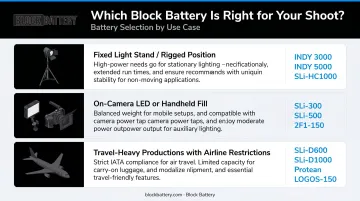
Match the battery class to how the light is being used:
| Use Case | Recommended Options |
|---|---|
| Fixed light stand or rigged position | SLi-D600, SLi-D1000, INDY series |
| On-camera LED or handheld fill | 2F1-150, compact V-mount |
| Travel-heavy productions with airline restrictions | Protean, LOGOS-150 modular systems |
Airline Compliance
Per FAA PackSafe guidance, airline rules catch more location crews off guard than almost any other logistics issue:
- Batteries ≤100Wh: carry-on permitted, no airline approval required
- Batteries 101–160Wh: carry-on only, require airline approval, limited to two per passenger
- Batteries above 160Wh: not permitted on passenger aircraft as carry-on
IATA's 2025 guidance aligns with these thresholds. Spare lithium batteries must travel in carry-on luggage only — checked bags are not permitted regardless of capacity.
Block Battery offers travel-designed solutions including the Protean and LOGOS-150 modular systems built around cartridges under 100Wh, specifically to navigate these airline restrictions without sacrificing professional capacity.
Connector Types and Compatibility
Three connection standards power most professional video lights from external batteries:
| Connector | Common Use | Notes |
|---|---|---|
| D-tap (P-tap) | Cinema/broadcast V-mount systems | Most widely used; rated up to 10A per Cable Techniques connector specs |
| XLR 4-pin | Broadcast ENG fixtures | Neutrik NC4MX rated 10A per contact, <50V |
| USB-C PD | Small LED fixtures under 100W | Standard PD caps at 100W; PD 3.1 enables up to 240W but hardware support varies |
Your fixture's input determines which standard applies — most cinema and broadcast rigs run D-tap or XLR 4-pin, while USB-C PD suits compact LED panels where draw stays under 100W.
Verify connector compatibility before purchasing. D-tap to USB-C PD cables are readily available, and Block Battery manufactures the VMA-4XLR adapter for Gold-Mount to B-Mount/V-Mount conversions. That said, adapters introduce an additional point of failure under sustained high-current loads. If you're relying on one on set:
- Test the adapter under load before shoot day
- Carry a spare — especially on high-draw fixtures
- Avoid using adapters as a permanent solution for mismatched systems
Best Practices for Using Battery Packs on Location
Hot-Swap Protocol
Have a second battery charged and ready before the first one depletes. The goal is zero shooting downtime during a swap. When one battery runs low, keep a second fully charged unit physically at hand: on a charger nearby or staged on the light stand cart. A mid-take power failure is far more disruptive than a brief planned swap between setups.
Block Battery's Linkey Block system takes this further, allowing multiple battery modules to link together for extended runtime. That makes it particularly useful for long uninterrupted scenes or live event coverage where any swap is off the table.
Pre-Production Battery Checks
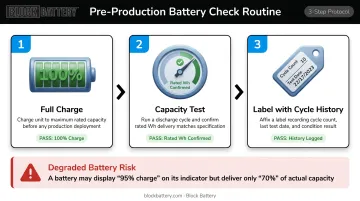
Every battery in the kit should be:
- Fully charged before leaving for location
- Capacity-tested to confirm it's delivering close to its rated Wh
- Labeled with its cycle history or condition
A battery showing 95% charge state but delivering only 70% of its rated capacity due to cycle degradation is a liability, not an asset. Test before you travel — not once you're already on set.
Battery Rotation on Multi-Day Shoots
A few simple rotation habits protect your fleet on longer shoots:
- Use the most-cycled batteries first each day
- Keep newer, higher-capacity units in reserve for critical scenes
- Track cycle counts per unit across a large fleet to predict replacements before a failure forces the decision
Transport, Storage, and Safety Guidelines
Mishandled lithium-ion batteries don't just fail — they fail dangerously. These handling rules apply from wrap day through the next call time.
Storage between shoot days:
- Store at partial charge (Panasonic's lithium-ion guidance recommends 30–50% capacity for long-term storage)
- Keep away from high heat — 60°C is the upper thermal limit for most lithium-ion cells, with charging capped at 45°C
- Use padded cases with physical protection from impact
Per NFPA, lithium-ion battery fires most commonly result from physical damage (penetration or crushing), electrical faults (overcharging), exposure to water, or overheating. Impact damage to cells is a real risk in production environments — battery cases deserve the same handling care as your camera bodies.
Those same physical risks multiply the moment batteries leave the production van and enter an airport.
For air travel:
- All spare lithium batteries must travel in carry-on luggage — checked bags are prohibited
- Tape or cap terminals to prevent short circuits
- Carry documentation of each battery's Wh rating when traveling internationally
- Declare batteries above 100Wh when required by the airline
Frequently Asked Questions
Can you use a power bank for LED lights?
Standard consumer power banks can power small LED video lights under 30W via USB-C. For professional fixtures above that threshold, voltage and current limitations make them unsuitable — most professional fixtures require higher voltage and sustained amperage than any consumer power bank delivers.
How long can a power bank power LED lights?
Runtime depends on the battery's Wh capacity and the light's wattage draw. A 100Wh battery powering a 20W light will run approximately 4–5 hours accounting for real-world efficiency losses. Use the formula: Runtime = Battery Wh ÷ Light Wattage, then apply a 15–20% efficiency discount for real-world runtime.
What is the difference between a V-mount battery and a regular power bank for video lights?
V-mount batteries deliver higher sustained voltage (14.4V nominal, up to 28.8V or 30V on multi-voltage systems) and are available beyond 300Wh — engineered for professional cinema fixtures. Consumer power banks top out at USB voltage profiles (5V–20V) and aren't built for the sustained current loads that professional lighting demands.
How do professionals light for video on location?
Professional location setups typically pair a key light (100W–400W+ LED), a fill, and a background or practical light. Without AC power, each fixture runs off V-mount batteries or a DC power station matched to its voltage and wattage spec.
How many batteries do I need for a full day location shoot?
Determine total light wattage, divide battery Wh by that figure to get runtime per battery, then calculate how many batteries cover your shooting hours. Add buffer for downtime and efficiency losses. Check the fixture manufacturer's spec sheet for actual power draw at your working dimmer level — rated wattage and real draw often differ.
Is it okay to charge a camera with a power bank?
Most modern cameras charge safely via USB-C power banks. For professional production, using a battery with dedicated camera output ports — D-tap or USB-C PD — is more practical, allowing you to run a light and charge a camera simultaneously from one unit.