Introduction
Lithium batteries power virtually everything on a modern film set — from cinema cameras and wireless follow focus systems to LED panels and sound carts. Shipping them internationally by air means navigating a rulebook that gets updated every year, and the 2026 edition brings changes that directly affect how production companies must prepare, label, and route battery shipments.
The IATA 2026 Lithium Battery Guidance Document, published January 1, 2026, is based on the 2025–2026 ICAO Technical Instructions and the 67th Edition of the IATA Dangerous Goods Regulations (DGR). This guide covers battery classifications, key 2026 rule changes, packing instructions, aircraft restrictions, and marking and documentation requirements — with practical guidance for production crews shipping battery kits to international shoots.
Key Takeaways:
- Standalone lithium ion batteries (UN 3480) must ship at ≤30% SoC; as of January 1, 2026, this extends to certain UN 3481 batteries packed with equipment
- Standalone batteries (UN 3480, UN 3090, UN 3551) are forbidden as cargo on passenger aircraft
- Sodium ion batteries are now formally integrated under UN 3551 and UN 3552
- The Lithium Battery Mark no longer requires a telephone number; QR codes can satisfy test summary access
- Cinema-grade batteries commonly exceed 100 Wh, placing them firmly in Section IA regulated territory
What Is the IATA 2026 Lithium Battery Guidance Document?
IATA (International Air Transport Association) publishes this guidance document to help shippers comply with rules for transporting lithium metal, lithium ion, and sodium ion batteries by air. The 2026 edition aligns with both the 2025–2026 ICAO Technical Instructions and the IATA DGR 67th Edition.
Three things this document is not:
- A replacement for formal dangerous goods training — Section IB shipments require DGR 1.5 training; Section II requires DGR 1.6 adequate instruction
- An override of operator-specific rules — many carriers impose restrictions beyond the IATA baseline
- A substitute for UN 38.3 test documentation, which remains a separate requirement for battery cell and pack certification
The provisions in the DGR regarding lithium and sodium ion batteries are also found in the IATA Battery Shipping Regulations (BSR) 13th Edition (2026), which adds classification flowcharts and detailed packing and documentation examples — useful for freight forwarders handling large or multi-battery production shipments.
Battery Types and UN Classifications Under IATA 2026
Understanding which UN number applies to your batteries determines everything else: packing instructions, SoC limits, aircraft restrictions, and documentation.
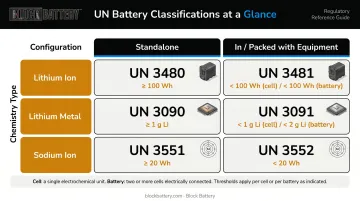
Lithium Ion Batteries (UN 3480 / UN 3481)
Rechargeable batteries where lithium exists only in ionic form, including lithium polymer variants. Used in mobile phones, laptops, and professional cinema cameras.
- UN 3480 — standalone lithium ion batteries
- UN 3481 — lithium ion batteries in or packed with equipment
Wh = nominal voltage × ampere-hour capacity. Professional cinema batteries commonly exceed 100 Wh, placing them in the most regulated tier — the Block Battery SLi-D600, for example, lands at 608 Wh, and the SLi-D1000 reaches 970 Wh.
Power banks are classified as batteries, not equipment, and must be assigned to UN 3480 or UN 3090 as applicable.
Lithium Metal Batteries (UN 3090 / UN 3091)
Primary (non-rechargeable) cells with lithium metal or alloy as the anode. Common in watches, temperature data loggers, and defibrillators.
- UN 3090 — standalone lithium metal batteries
- UN 3091 — lithium metal batteries in or packed with equipment
For metal batteries, the key measurement is lithium content in grams, not Wh. Section IA applies when cells exceed 1 g or batteries exceed 2 g of lithium content.
Sodium Ion Batteries (UN 3551 / UN 3552)
New to the 2026 edition as a newly added category. Rechargeable systems with no metallic sodium in either electrode, with organic electrolyte.
- UN 3551 — standalone sodium ion batteries
- UN 3552 — sodium ion batteries in or packed with equipment
Sodium ion batteries with aqueous alkali electrolyte are a separate category, transported as UN 2795 — not covered under UN 3551/3552.
Cell vs. Battery: Why the Distinction Matters for UN Classification
Which UN number applies to your shipment depends in part on whether you're shipping a cell or a battery. The UN Manual of Tests and Criteria draws a clear line between the two.
Per the UN Manual of Tests and Criteria:
- Cell — a single encased electrochemical unit with one positive and one negative electrode
- Battery — two or more cells connected by permanent means, including case, terminals, and markings
Battery packs, modules, and assemblies designed to power another device are treated as batteries for regulatory purposes — not cells. This distinction directly determines which packing instruction and quantity limits apply to your shipment.
Key 2026 Updates: What Changed
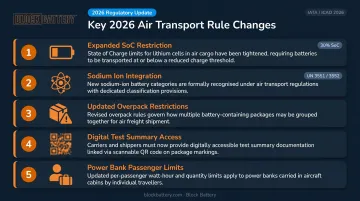
Five changes in the 2026 edition directly affect how production companies ship, consolidate, and travel with lithium batteries — here's what matters operationally.
Expanded State of Charge Restrictions
The most significant change: from January 1, 2026, the 30% SoC requirement now applies to:
- Lithium ion batteries packed with equipment (UN 3481) under PI 966 Section I and Section II above 2.7 Wh
- Vehicles powered by lithium ion or sodium ion batteries above 100 Wh
Previously, the 30% SoC rule applied mainly to standalone UN 3480 shipments. This expansion means that camera kits shipped with batteries installed now face the same partial discharge requirement.
Sodium Ion Battery Integration
UN 3551 and UN 3552 are now fully incorporated across classification, packing, marking, and aircraft restriction rules. Sodium ion batteries under these entries must meet UN Manual of Tests and Criteria Part III, Sub-section 38.3, the same testing framework as lithium ion batteries. In practice, this means documentation requirements, overpack restrictions, and aircraft-type limits now apply to sodium ion cells just as they do to lithium ion.
Updated Overpack Restrictions
Packages containing the following may not be placed in an overpack with Class 1 (except 1.4S), Division 2.1, Class 3, Division 4.1, or Division 5.1 goods:
- UN 3090 under PI 968 Section IA/IB
- UN 3480 under PI 965 Section IA/IB
- UN 3551 under PI 976
This matters for freight forwarders consolidating mixed-commodity shipments.
Digital Test Summary Access
IATA now explicitly accepts QR codes or URLs for making the Lithium Battery Test Summary available, whether placed on the battery, the packaging, or the transport documentation. Paper copies inside every package are no longer required.
Power Bank Passenger Restrictions
The 2026 guidance introduces tighter limits for passengers, addressed in the companion Passengers Travelling with Lithium Batteries guidance document. Passengers are limited to a maximum of two lithium ion power banks not exceeding 100 Wh each, which must not be recharged from aircraft power supplies or stored in overhead lockers.
These updates collectively tighten requirements across freight consolidation, passenger carry-on, and digital documentation — meaning production teams need to audit both their shipping workflows and what crew members bring on board.
Packing Instructions, State of Charge, and Aircraft Restrictions
The 30% SoC Rule
Standalone lithium ion batteries (UN 3480) and sodium ion batteries (UN 3551) must be shipped at no more than 30% of rated capacity. Shipments above 30% SoC require approval from both the State of Origin and the State of the Operator under Special Provision A331.
In practice, batteries must be partially discharged before handover to the carrier. For production companies, this means building discharge time into pre-shipment logistics — well before the freight desk handoff, not the morning of departure.
Passenger Aircraft Prohibitions
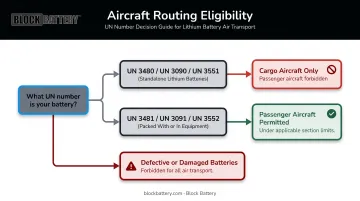
Standalone batteries — UN 3480, UN 3090, and UN 3551 — are forbidden as cargo on passenger aircraft. Packages prepared under Section IA or IB of their respective packing instructions must carry the Cargo Aircraft Only label.
This affects how battery shipments are booked and routed. A production coordinator who assumes any available cargo flight works will run into problems when their forwarder needs a freighter-only route.
Packing Instruction Tiers
| Tier | Standalone UN 3480 Threshold | Standalone UN 3090 Threshold |
|---|---|---|
| Section IA | Cells >20 Wh or batteries >100 Wh | Cells >1 g or batteries >2 g lithium content |
| Section IB | Cells ≤20 Wh and batteries ≤100 Wh | Cells ≤1 g and batteries ≤2 g lithium content |
Note: standalone UN 3480 (PI 965) and UN 3090 (PI 968) shipments in 2026 are classified as Section IA or IB — not Section II. Section II appears for certain packed-with-equipment configurations.
Special Provision A201 — Lithium Metal on Passenger Aircraft
Lithium metal batteries may only travel on passenger aircraft with approval from:
- State of Origin
- State of Destination
- State of the Operator
One exception applies: a single consignment for urgent medical need, with prior approval from the State of Origin and the operator. Everything else ships freighter-only.
Defective, Damaged, or Recalled Batteries
These are strictly forbidden for air transport. Any battery identified by the manufacturer as defective for safety reasons — or damaged with potential to produce dangerous heat, fire, or short circuit — cannot be shipped by air. Production companies and rental houses managing returns must supply appropriate packaging, required hazmat markings, approved transport methods, and written notice of shipping restrictions to anyone returning these batteries.
Marking, Labeling, and Documentation Requirements
Lithium Battery Mark
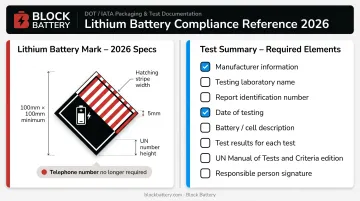
The 2026 mark no longer requires a telephone number. Specifications:
- Minimum size: 100 mm × 100 mm (reducible to 100 mm × 70 mm if package size requires)
- Red diagonal hatchings: at least 5 mm wide
- UN numbers: at least 12 mm high
Section IA and IB shipments must also carry the Cargo Aircraft Only label where applicable.
Lithium Battery Test Summary Requirements
The test summary must include:
- Manufacturer name and contact
- Test laboratory name and contact
- Unique test report ID
- Test date
- Battery description: type, mass, Wh rating or lithium content
- List of tests conducted with pass/fail results
- Reference to the applicable UN Manual of Tests and Criteria edition
- Signature, name, and title of the responsible person
The summary must be made available to carriers and authorities — not necessarily included physically in every package. A QR code or URL on the packaging or transport documentation meets the availability requirement.
Shipper's Declaration
Beyond the test summary, Section IA and IB shipments are fully regulated dangerous goods shipments requiring a Shipper's Declaration for Dangerous Goods. Freight forwarders completing declarations should confirm consignment scope with their DGR-trained personnel, as quantity counting rules affect how the declaration is completed.
What Film and Production Professionals Need to Know
Cinema-grade batteries used with cameras like the ARRI Alexa, RED V-Raptor, and Sony Venice series routinely exceed 100 Wh. A standalone battery above 100 Wh falls under UN 3480 PI 965 Section IA — the most regulated tier, with a 30% SoC limit and a cargo-aircraft-only requirement. This is not a consumer electronics travel question; it is a dangerous goods logistics problem.
Pre-Shipment Checklist for Production Companies
- Confirm Wh rating for each battery in the shipment — this determines packing instruction tier
- Discharge to ≤30% SoC before handover for standalone UN 3480 and UN 3551 shipments; also required for UN 3481 packed-with-equipment from January 1, 2026
- Verify the correct UN number — standalone vs. packed with equipment changes the classification
- Apply the Lithium Battery Mark to the outer package; add Cargo Aircraft Only label for Section IA/IB shipments
- Confirm your carrier's battery policy — many operators impose restrictions beyond IATA minimums
- Have the test summary accessible — via QR code, URL, or paper documentation
These requirements compound quickly across a full camera package. Working with a battery supplier that engineers products around shipping compliance reduces documentation burden before the freight even leaves the facility. Block Battery — a veteran-owned American manufacturer whose management team brings 30 years of professional broadcast and cinema battery experience — engineers products with shipping compliance in mind. The LOGOS-150 modular cartridge system and Protean series (which splits into two 75 Wh carry-on-compliant units) are purpose-designed to simplify air transport documentation when shipped or carried in a disassembled state.
Traveling Crew Members
Production crew members carrying batteries as passengers face separate restrictions under the IATA passenger guidance document. Key passenger rules to know before traveling with a personal battery kit:
- Power banks are limited to two units, each not exceeding 100 Wh
- Spare lithium-ion batteries must travel in carry-on luggage — not checked baggage
- International itineraries may impose additional airline-specific restrictions beyond IATA minimums
Review these limits against your specific carrier's policy before departure.
Frequently Asked Questions
What are the IATA regulations for the air transport of lithium batteries?
IATA regulations for lithium batteries are set out in the Dangerous Goods Regulations (DGR), currently the 67th Edition for 2026, supplemented by the annual Lithium Battery Guidance Document. Key rules govern classification by UN number, state of charge limits, packing instructions, aircraft type restrictions, and marking and documentation requirements.
What is the IATA code for lithium batteries?
All lithium and sodium ion batteries fall under Class 9 dangerous goods. The primary UN numbers are:
- UN 3480 — lithium ion, standalone
- UN 3481 — lithium ion, in or packed with equipment
- UN 3090 — lithium metal, standalone
- UN 3091 — lithium metal, in or packed with equipment
- UN 3551 — sodium ion, standalone
- UN 3552 — sodium ion, in or packed with equipment
What is the state of charge limit for shipping lithium batteries by air in 2026?
Standalone lithium ion batteries (UN 3480) and sodium ion batteries (UN 3551) must ship at no more than 30% of rated capacity. From January 1, 2026, this restriction extends to lithium ion batteries packed with equipment (UN 3481) above 2.7 Wh, unless State approvals are obtained under Special Provision A331.
Can lithium batteries be shipped on passenger aircraft?
Standalone lithium ion batteries (UN 3480) and sodium ion batteries (UN 3551) are forbidden as cargo on passenger aircraft and require Cargo Aircraft Only routing. Lithium metal batteries (UN 3090) follow the same general restriction — though they may travel on passenger aircraft under specific State approvals per Special Provision A201.
What is required on a lithium battery test summary?
The test summary must include:
- Manufacturer's name and contact information
- Test laboratory details and a unique report ID
- Test date and battery description (type, mass, Wh rating or lithium content)
- Test results, the applicable UN Manual edition reference, and a responsible person's signature
It must be made available to carriers and authorities on request but does not need to be physically included in every package.
What changed in the IATA 2026 Lithium Battery Guidance Document compared to prior editions?
Key 2026 updates include:
- 30% SoC requirement extended to UN 3481 batteries packed with equipment and electric vehicles
- Formal integration of sodium ion battery rules (UN 3551/3552)
- Updated overpack restrictions and new passenger power bank limits (maximum two units, ≤100 Wh each)
- QR codes and URLs now accepted for test summary access