Introduction
You're three hours into a golden-hour desert shoot. The ARRI Alexa is rolling, the SkyPanel is dialed in, and the client is happy. Then the battery dies. Not the camera battery — the power station feeding the lights. The shot is gone, along with the crew's momentum.
For professional productions, power failure isn't a minor inconvenience. It's a budget problem with real consequences: idle crew costs, missed lighting conditions that can't be recreated, and schedule overruns that cascade across the rest of the shoot.
This guide is for production professionals (1st ACs, gaffers, DITs, and producers) who need reliable, high-capacity mobile power on location. We cover the right battery solutions for professional cinema rigs, how to calculate your watt-hour budget, and the field practices that keep crews rolling when grid power isn't an option.
Key Takeaways:
- Professional cinema rigs draw 65–140W continuously, far beyond consumer power stations
- V-mount and Gold Mount batteries are the backbone of on-camera power for remote shoots
- High-capacity systems (3,000–6,000 Wh) handle lighting loads that standard stations can't sustain
- Calculate your watt-hour budget before leaving; always build in a 20–30% buffer
- Battery rotation, labeling, and temperature management are field-critical disciplines
Why Remote Shoots Demand Professional-Grade Power Solutions
The Wattage Gap Is Bigger Than You Think
Consumer content about "remote power" focuses on charging a mirrorless camera or drone between shots. Professional cinema production is a different category entirely.
Consider the camera body alone:
- ARRI Alexa 35: ~90W continuous draw
- ARRI Alexa Mini LF: ~65W recording ARRIRAW at 24fps
- Sony VENICE 2 (8.6K): ~76W at 25°C with no accessories
- RED V-RAPTOR [X]: 65W at 24fps, up to 75W at 8K/120fps in high ambient temperature
- Phantom Flex4K: ~140W typical with CineMag
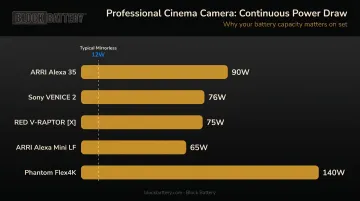
Add a monitor, wireless transmitter, and onboard recorder to that rig and you're pulling significantly more. A consumer mirrorless camera might draw 8–12W. That's a 10x difference in power demand before a single light turns on.
Why Generators Fall Short
Gas generators have been the default answer for decades, but they create real problems on modern productions:
- Audio contamination: The Honda EU2200i runs at 57 dB(A) at rated load — audible on any location audio recording
- Exhaust fumes: Fumes must be vented away from enclosed spaces, dressing rooms, and air intakes per industry safety guidelines
- Fuel logistics: Getting fuel to a mountain ridge or desert wash adds complexity, cost, and risk
- Run-and-gun incompatibility: Documentary and guerrilla-style productions can't drag a generator to every setup
A power failure mid-shot costs more than the battery that could have prevented it — idle crew on day rates, a missed golden hour, and a controlled setup that took hours to build going dark. Power planning belongs in the production budget conversation, not as an afterthought on the gear list.
The practical answer is a layered battery system: V-mount and Gold Mount packs for the camera rig, high-capacity units for lighting and base camp, and planned charge cycles managed throughout the shooting day.
Your Remote Power Arsenal: V-Mount, Gold Mount, and High-Capacity Systems
V-Mount and Gold Mount Battery Systems
V-mount and Gold Mount batteries are the industry standard for professional camera rig power. A single battery mounts to the back of the rig and powers the camera body, monitor, wireless transmitter, and accessories simultaneously — eliminating the need to track individual batteries for each component.
The practical advantages on set are real:
- Battery swaps take seconds without disassembling the rig
- A standardized format simplifies what you pack for location
- D-Tap and P-Tap outputs power accessories like EVFs, transmitters, and tethering stations directly from the battery
Block Battery — a veteran-owned American manufacturer headquartered in Indianapolis — was founded by a management team with 30 years of professional broadcast and cinema battery experience. Their lineup spans from the compact 2F1-150 (150 Wh) for run-and-gun B-cam work all the way to the SLi-D1000 (970 Wh) for extended A-cam shoot days on platforms like the ARRI Alexa, RED V-Raptor, Sony VENICE, and Phantom Flex 4K.
For productions running mixed camera packages — a RED Komodo at 14V alongside an ARRI Alexa 35 at 28V, for example — Block Battery's Protean 4 and Artisan Block dual-voltage systems let a single battery infrastructure serve both cameras, eliminating separate battery inventories.
High-Capacity Battery Systems for Lighting and Base Camp
Lighting is where most remote productions underestimate their power needs. A single ARRI SkyPanel S60-C draws 400W; an Aputure LS 1200d Pro pulls 1,440W. No consumer-grade power bank touches these numbers.
High-capacity professional battery systems fill this role — replacing generators without the noise, fumes, or fuel runs. When evaluating them for production use, prioritize:
- Total watt-hour capacity relative to your lighting rig's draw and shoot day length
- Continuous output wattage — not all units can sustain the draw of large professional fixtures
- Cell chemistry — LFP (Lithium Iron Phosphate) chemistry offers cycle life beyond 2,000 cycles and approximately 30% lower cost than comparable technologies, with strong thermal stability for demanding production environments
- Multi-voltage output to cover different fixture and accessory voltage requirements
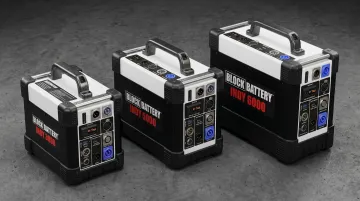
Block Battery's INDY series — the INDY 3000 (3,000 Wh), INDY 5000 (5,000 Wh), and INDY 6000 (6,000 Wh) — addresses each of those requirements directly. Multi-voltage output (14.4V, 24V, 28.8V, 30V) covers SkyPanel arrays, HMI fixtures, Aputure and Astera lighting, sound carts, and video village setups. All three units are built to sustain those loads across a full feature film or commercial shoot day without grid access.
Two Additional Tools for Edge Cases
When a full high-capacity system is more than the job requires, two lighter approaches are worth keeping in your toolkit:
- Run a laptop or tethering station directly from a V-mount battery using a D-Tap to AC adapter — no separate power station needed for low-draw accessories
- Tap a vehicle's alternator via a dedicated secondary battery and inverter for productions shooting within reach of a grip truck or production vehicle
Everything on Your Rig That Needs Power
Camera Bodies and Accessories
The camera body is just the starting point. A full professional cinema rig typically includes:
- External monitor or EVF
- Wireless video transmitter (Teradek Bolt, Hollyland, etc.)
- Onboard audio recorder or mixer
- Onboard SSD recorder
- Sometimes a focus motor controller
Every accessory draws from the same V-mount source. The combined wattage of a fully accessorized rig is far higher than the camera body spec alone. Calculate the total — don't just look at the camera's number on the spec sheet.
Lighting Equipment
For remote productions with any significant lighting package, this is the largest power draw on set:
| Fixture | Max Power Draw |
|---|---|
| ARRI SkyPanel S60-C | 400W |
| ARRI SkyPanel S360-C | 1,500W |
| Aputure LS 600d Pro | 720W |
| Aputure LS 1200d Pro | 1,440W |
| Litepanels Gemini 2x1 Soft | 325W |
| K5600 Joker² 800W HMI | 800W |
Productions running multiple large fixtures will need a high-capacity battery system scaled to handle the total draw — not a consumer power station rated for 1,000W continuous that will trip on a single 1,200W fixture.
Monitoring, Data, and Communication
These devices draw less wattage but need consistent power all day:
- DIT laptop for on-site color checks and data management
- Client monitor at video village
- External SSDs and card readers
- Satellite communication device
- Crew phones and radios
USB-C outputs on your high-capacity system can handle most of this workflow load, keeping it separate from your dedicated lighting power.
Drone Support
Productions deploying drones need dedicated attention to flight battery cycling. Charge times vary significantly by platform:
- DJI Inspire 3 TB51 (98.8 Wh) — roughly 35–55 minutes depending on charge mode
- Matrice 350 RTK TB65 (263.2 Wh) — approximately 60–70 minutes for a full charge
A portable battery system dedicated to drone cycling at base camp keeps aerial capture running in parallel with ground shooting — without pulling power from the camera rig or lighting circuits.
Calculating Your Power Budget Before You Go
The Watt-Hour Method
For each device on the shoot, run through four steps:
- Find the wattage draw from the manufacturer spec sheet
- Multiply by hours of expected use per shoot day
- Sum every device to get your total daily watt-hour requirement
- Add 20–30% buffer for conversion inefficiency, temperature losses, and extended days
Worked example — 10-hour shoot day:
| Device | Draw | Hours | Wh |
|---|---|---|---|
| ARRI Alexa Mini LF rig (with accessories) | ~90W | 10 | 900 Wh |
| ARRI SkyPanel S60-C | 400W | 8 | 3,200 Wh |
| Litepanels Gemini 2x1 | 325W | 8 | 2,600 Wh |
| DIT laptop | ~65W | 10 | 650 Wh |
| Subtotal | 7,350 Wh | ||
| +25% buffer | ~9,200 Wh |
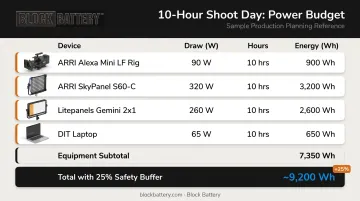
This example shows why two LED panels alone can demand more capacity than some entire consumer power station lineups.
Translating the Budget to a Battery Plan
With your watt-hour total, map it to specific batteries:
- Camera rig: Divide your total rig Wh by single-battery capacity. A 900 Wh draw across 10 hours fits three SLi-D600s (608 Wh each) on rotation, or two SLi-D1000s (970 Wh each) with a spare in reserve
- Lighting: Match your high-capacity system to the lighting draw. The INDY 3000 or INDY 5000 are the right scale for mid-to-large professional lighting rigs on a full shoot day
For multi-day shoots without grid access, plan your battery count around full rotation cycles rather than minimum coverage. Bringing a second INDY-series unit lets one charge while the other runs, keeping production continuous across consecutive shooting days.
Build in Redundancy
Never run at calculated minimum. Standard practice:
- Bring more capacity than your calculation requires
- Keep one battery designated as an emergency reserve — fully charged, untouched until needed
- Assign a crew member to monitor power levels and flag swap timing before you're running on empty
Field Power Management Tips for All-Day Shoots
Temperature Awareness
Lithium batteries are sensitive to temperature at both extremes, and the effects are real in the field.
In cold conditions (high-altitude mountains, pre-dawn desert, winter locations):
- Cold temperatures reduce usable capacity measurably — LiFePO4 cells at 0°C retain around 91% capacity, with steeper losses below freezing
- Keep batteries in an insulated bag or case when not on the rig
- Allow batteries to reach ambient temperature before charging in extreme cold
- Plan additional capacity into your budget — the spec sheet numbers were measured at room temperature
In heat (desert midday, enclosed spaces):
- Elevated temperatures can cause capacity deterioration and trigger thermal protection shutdowns
- Keep power stations shaded and away from direct sun exposure
- Never leave batteries in a sealed vehicle in direct sunlight
Battery Cycling and Labeling
On any multi-battery location shoot, a labeling and rotation system is non-negotiable:
- Number every battery before leaving for location
- Track which are depleted vs. ready using a simple whiteboard or tape system at the charging station
- Keep a dedicated charger cycling depleted batteries constantly throughout the day
- Never pick up a battery without checking its status — dead batteries end shots
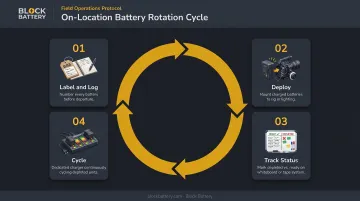
On larger productions, this is typically an AC/power department responsibility. On smaller crews or solo documentary work, assign it explicitly — even if that person is you.
Backup Planning and Gear Protection
- Designate one fully charged battery as your emergency reserve and don't touch it until you have no other option
- Use surge protection for sensitive camera and monitoring gear when connecting to AC outlets
- Transport batteries in dedicated cases — not loose in a gear bag, particularly over rough terrain
- Waterproof or padded storage matters on location shoots where weather or terrain is a factor
Block Battery's systems are built for the physical demands of location work, but proper transport and storage habits extend their service life regardless of the conditions you're shooting in.
Frequently Asked Questions
Can a power bank power a camera?
Consumer power banks can power some mirrorless cameras via USB-C with a dummy battery adapter, but professional cinema cameras like the ARRI Alexa or RED V-Raptor require V-mount or Gold Mount battery systems due to their much higher continuous power demands. Professional cinema camera platforms don't accept USB-C PD as a primary power input.
What is the difference between V-mount batteries and high-capacity battery systems for film production?
V-mount batteries mount directly to the camera rig and power the camera body and accessories with fast-swap convenience. High-capacity battery systems are stationary units that power high-draw lighting equipment, laptops, and charging stations. Professional productions typically run both simultaneously — they solve different power problems on the same set.
How do I calculate how many batteries I need for a remote shoot?
Total the watt-hour draw of every device multiplied by hours of expected use, then divide by the capacity of a single battery. Add a 20–30% buffer for real-world losses. That gives you your minimum count — always bring more than the minimum.
What professional cameras use V-mount or Gold Mount batteries?
Most professional cinema and broadcast cameras support V-mount or Gold Mount natively or via adapter — including the ARRI Alexa series, RED V-Raptor and Komodo, Sony VENICE and CineAlta, Blackmagic URSA, Phantom Flex 4K, and Canon Cinema EOS. Block Battery covers this full range across V-Mount, Gold Mount, and 28V B-Mount configurations.
How do extreme temperatures affect battery performance on a remote shoot?
Temperature extremes cut into real-world capacity in opposite ways:
- Cold: Reduces usable capacity and output — insulate batteries when not in use and budget for extra units
- Heat: Accelerates capacity loss and can trigger thermal shutdowns — keep units shaded and out of direct sun
Factor temperature into your power budget any time conditions fall outside 60–77°F (15–25°C).