This guide compares lithium-ion camera batteries against NiMH and alkaline alternatives, with a focus on what actually matters in professional production environments — voltage stability, runtime reliability, weight, and total cost of ownership.
The short answer: lithium-ion batteries are the superior choice for professional camera use. Here's why.
Key Takeaways
- Li-ion offers 100–265 Wh/kg energy density versus 60–120 Wh/kg for NiMH — a significant weight and runtime advantage
- Li-ion's near-flat voltage curve prevents the premature shutdowns alkaline batteries cause
- V-mount and Gold-mount Li-ion systems are the professional standard for cinema cameras (Alexa, RED, Sony Venice, Phantom)
- Cold sensitivity and higher upfront cost are the key trade-offs production teams should plan around
- Cycle life ranges from 300 to 2,000 cycles depending on cell design
What Makes Lithium-Ion Batteries Different?
Energy Density: Why It Matters On Set
The most defensible advantage Li-ion holds over NiMH is specific energy. Battery University lists Li-ion at 100–265 Wh/kg and NiMH at 60–120 Wh/kg, with the Engineering ToolBox citing comparable figures of 100–200 Wh/kg versus 60–80 Wh/kg.
A Li-ion pack stores roughly twice the energy per kilogram compared to NiMH. For a shoulder-mounted cinema camera or a handheld run-and-gun setup, that translates directly to less weight on the rig and longer runtime between swaps.
Modern professional cinema cameras draw 60W to 135W just at the camera body:
- ARRI ALEXA 35: 85–135W while recording
- RED V-RAPTOR 8K: 60–75W depending on resolution and frame rate
- Sony VENICE 2: approximately 76W without accessories
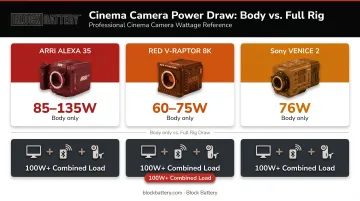
Add an onboard monitor, wireless video transmitter, and follow-focus motor, and total rig draw climbs well past 100W. Only high-capacity Li-ion systems in V-mount or Gold-mount form factors can sustain that load across a full production day.
Voltage Stability and the Discharge Curve
Li-ion cells maintain a flat voltage output through most of their discharge cycle. Alkaline cells start at 1.5V per cell and slope downward continuously; Energizer's own technical documentation confirms that devices typically operate across a range of 1.6V to 0.9V per cell.
Professional cameras use voltage-based shutoff thresholds. An alkaline battery may still hold usable chemical energy but cross that cutoff point prematurely, cutting power before the cell is truly depleted. On a critical take, that's an unacceptable risk.
The Battery Management System (BMS)
Quality Li-ion batteries include a Battery Management System (BMS): protection circuitry that monitors the pack in real time. According to Texas Instruments, Li-ion protection ICs detect:
- Overvoltage during charging
- Undervoltage during discharge
- Overcurrent on discharge
- Short circuit conditions
UL notes that internal faults or external conditions trigger thermal runaway, the failure mode associated with Li-ion fires. A properly designed BMS is the primary safeguard — which is why pack construction quality, not just cell chemistry, determines real-world safety on set.
Li-Ion Form Factors for Professional Production
Not all Li-ion batteries are the same format:
- Proprietary packs (LP-E6 style): Consumer and prosumer cameras; limited capacity and no accessory power outputs
- V-mount / V-lock: The dominant standard for Sony cinema and broadcast cameras, RED cameras, and ENG/EFP production
- Gold-mount / 3-stud: The established standard in ARRI Alexa-based feature film production
- 28V B-mount: Required for the latest generation: ARRI Alexa 35, Alexa Mini LF, and Sony Venice 2
Lithium-Ion vs. NiMH vs. Alkaline: How They Compare for Cameras
Side-by-Side Comparison
| Feature | Li-Ion | NiMH | Alkaline |
|---|---|---|---|
| Nominal Cell Voltage | 3.6V (stable) | 1.2V | 1.5V (declining) |
| Energy Density | 100–265 Wh/kg | 60–120 Wh/kg | N/A (single-use) |
| Cycle Life | 300–2,000 (source-dependent) | ~500–1,000 | Single-use |
| Self-Discharge | ~10%/month (Battery University) | ~30%/month | ~3%/year |
| Cold Performance | Reduced; chemistry-dependent | Degrades below -10°C | Degrades; reactions slow |
| Best Use Case | Professional cinema/broadcast | Consumer/prosumer | Emergency backup only |
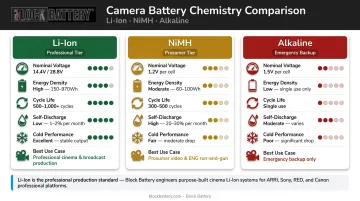
For professional production, Li-ion is the practical standard. NiMH and Alkaline are included here for comparison — understanding where they fall short clarifies why Li-ion dominates the cinema and broadcast market.
Self-Discharge and Storage
Self-discharge affects any production that stores batteries between shoots. Battery University lists Li-ion self-discharge at approximately 10% per month and NiMH at approximately 30% per month. Alkaline primary cells lose around 3% of capacity per year at 20°C — but they're non-rechargeable, making it a shelf-life figure, not a production metric.
For a rental house or production company that charges batteries on Friday and ships them Monday, Li-ion's lower self-discharge rate translates directly into more reliable capacity on arrival.
Cycle Life and Cost Per Use
Self-discharge reliability is only part of the equation — cycle life determines long-term cost per use. Figures vary by source:
- Battery University: Li-ion 300–500 cycles
- Engineering ToolBox: Li-ion 500–2,000 cycles
- Panasonic NiMH handbook: NiMH approximately 500–1,000 cycles, with practical service life often cited as 2 years or 500 cycles
At even 500 cycles, a $300 V-mount battery costs $0.60 per charge cycle. A pack of AA alkaline batteries for a single shoot might cost $15–$25 and delivers zero cycles after that.
Why Lithium-Ion Batteries Are Better for Professional Camera Use
Handling Real Production Power Demands
Professional cinema cameras draw 60–135W at the body alone. Add accessories — onboard monitors, SmallHD or TVLogic displays, Teradek wireless video, Preston FIZ motors — and total rig consumption on an ARRI Alexa 35 or Sony Venice 2 package can exceed 200W during a sustained take.
NiMH cells at 1.2V nominal require far more cells in series to reach usable pack voltages, resulting in heavier, bulkier packs with lower practical energy output. Alkaline is simply not viable for sustained high-current loads — the voltage sag under load is severe.
V-Mount and Gold-Mount: The Production Standard
V-mount and Gold-mount Li-ion systems do more than power the camera body. ARRI and RED both officially document Gold-mount and V-lock / V-mount battery adapters, with D-tap / P-tap accessory power outputs that power:
- Onboard monitors
- Wireless video transmitters (Teradek, Hollyland, Accsoon)
- Follow-focus motors
- Lens control systems
- IFB / comms systems
No proprietary pack or AA format can replicate this. Powering an entire rig from a single battery source is exactly why V-mount and Gold-mount Li-ion became the production standard — and why runtime predictability matters so much on set.
Production Reliability and Predictable Runtime
On a feature film or commercial shoot, an unexpected battery failure means stopped cameras, disrupted talent, and costly re-takes. Productions build contingency budgets around equipment failure precisely because the consequences — halted takes, scrambled crew, rescheduled talent — compound quickly.
A high-quality Li-ion battery with a documented watt-hour rating lets 1st ACs and DITs plan shooting days with real math:
- 150Wh battery on a 75W rig → approximately 2 hours of runtime before buffer
- 600Wh pack on the same rig → roughly 8 hours
That math translates directly to fewer swap interruptions during takes and fewer surprises deep into a long shooting day.
Block Battery's Role in Professional Production
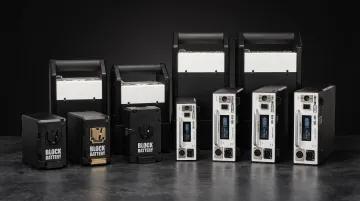
Block Battery, a veteran-owned American manufacturer led by a management team with 30 years of broadcast and cinema battery industry experience, builds V-mount and Gold-mount Li-ion systems across a range of production classes — from the compact 2F1-150 (150Wh) for ENG and run-and-gun applications, to mid-tier systems like the SLi-600 (600Wh) for A-cam feature film power, up to the INDY series (3,000–6,000Wh) for large lighting arrays, helicopter rigs, sound carts, and video village setups.
Productions running mixed-camera packages — an ARRI Alexa 35 alongside a RED V-Raptor, for example — can use Block Battery's Protean 4 (configurable 14V/28V) or Artisan Block to support both voltage architectures from a unified battery inventory, eliminating the need for two separate battery systems.
Limitations of Lithium-Ion Camera Batteries to Know About
Li-ion dominates professional production for good reason — but every format has trade-offs. Here's what to plan for before committing your power kit.
Higher upfront cost: V-mount and Gold-mount systems cost significantly more than alkaline packs or NiMH AA batteries. For smaller productions with limited budgets, this is a real consideration — though the cost-per-use math over hundreds of cycles usually favors Li-ion.
Cold temperature sensitivity: Low temperatures reduce available Li-ion capacity and runtime. Practical mitigation is straightforward:
- Keep spare batteries in insulated pouches or an interior jacket pocket during winter exteriors
- Build more battery margin into cold-weather shooting schedules
- Rotate batteries more frequently to keep cells at working temperature
Calendar aging and storage: Battery University notes that Li-ion ages even without cycling — and that high state-of-charge combined with heat accelerates that degradation. For long-term storage, Battery University advises keeping cells at 40–50% state of charge in a cool, dry location. Rental houses and production companies that shelf batteries fully charged for months are quietly shortening their usable life.
How to Choose the Right Lithium-Ion Battery for Your Camera
Key Specs to Evaluate
| Spec | What to Look For |
|---|---|
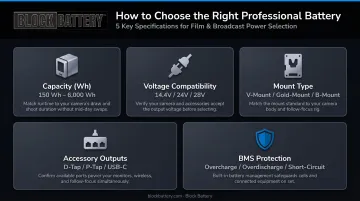
| Capacity (Wh) | Match to camera draw × expected runtime. A 100W rig needs ~100Wh per hour minimum |
| Voltage compatibility | 14.4V (RED, Sony FX), 24V (legacy ARRI), 28V/28.8V (Alexa 35, Alexa Mini LF, Venice 2) |
| Mount type | V-mount, Gold-mount, or 28V B-mount depending on your camera platform |
| Accessory outputs | D-tap, P-tap, USB-C for powering monitors, wireless, and follow-focus |
| BMS protection | Overvoltage, undervoltage, overcurrent, and short circuit protection |
Buy From Established Sources
Counterfeit and substandard Li-ion batteries are a documented risk. A 2023 peer-reviewed study on counterfeit lithium-ion cells found that counterfeit cells can lack the safety devices and internal protection circuits found in commercial cells. FAA/PHMSA safety documentation identifies counterfeit Li-ion battery risks including arcing, venting, extreme heat, and fire.
That risk makes sourcing decisions consequential. Block Battery is a veteran-owned American manufacturer with 30 years of management experience in the professional broadcast, video, and cinema battery industry — and has been a recognized supplier in the U.S. cinema market since 2007.
Care Practices That Extend Battery Life
- Store at 40–60% charge — not fully charged, not completely depleted
- Use a smart charger compatible with your specific battery system
- Avoid leaving batteries in vehicles or storage areas with extreme temperatures
- For fleet management, consider a cell balancer and analyzer to monitor individual cell health before issues compound
Frequently Asked Questions
Which battery is best for a camera?
For professional cinema and video production cameras, lithium-ion — specifically V-mount or Gold-mount systems — is the clear choice. Stable voltage, high energy density, and rechargeability make it the only viable chemistry for sustained professional production use. Consumer cameras typically use proprietary Li-ion packs that serve the same purpose at smaller scale.
How long do lithium batteries last for cameras?
Runtime per charge depends on camera draw and battery capacity. A 98Wh V-mount pack on a 75W camera rig yields roughly 60–75 minutes before the buffer threshold; a 150Wh pack extends that to two-plus hours. Total service life typically spans 300–1,000+ charge cycles, depending on cell quality, usage habits, and storage discipline.
Are lithium-ion batteries worth it for professional cameras?
Yes. The combination of reliable performance, long cycle life, and the ability to power full camera rigs — including accessories via D-tap outputs — makes Li-ion the cost-effective and operationally sound choice. The higher upfront cost amortizes across hundreds of charge cycles, making it the financially sound choice for any serious production.
Can you overcharge a lithium-ion camera battery?
Quality Li-ion batteries include a BMS that halts charging once full, preventing overcharge damage. However, using an incompatible or low-quality charger without these protections can damage cells. Always use a manufacturer-recommended charger matched to the specific battery system.
What is the difference between V-mount and Gold-mount Li-ion batteries?
Both are professional cinema battery form factors using Li-ion chemistry. V-mount uses a V-shaped sliding rail and locking lever — standard on Sony cinema and broadcast cameras and RED camera systems. Gold-mount (Anton Bauer-pattern, 3-stud) uses a rotational twist-lock mechanism common in ARRI Alexa-based feature film production.
How should I store lithium-ion camera batteries when not in use?
Store at approximately 40–60% state of charge in a cool, dry location — away from direct sunlight, heat sources, and metal objects that could cause a short circuit. Avoid leaving fully charged batteries on the shelf for months; high charge state combined with heat accelerates calendar aging.