Before diving in, one clarification matters: watts (W) and watt-hours (Wh) are not the same thing. Watts measure how much power the station can deliver at any moment. Watt-hours measure how much total energy is stored. A station can have a 500W output and 512Wh capacity — two separate but equally important specs. Confusing them is the most common buying mistake in this category.
This guide covers five top-tested stations, a plain-language breakdown of what 500W can and cannot run, and the selection criteria that actually matter — drawing on Block Battery's management team's 30 years of professional experience in the broadcast, video, and cinema battery industry.
Key Takeaways
- 500W is a combined device ceiling — run too many at once and the overload protection cuts power
- LFP (LiFePO4) chemistry lasts 2,500–3,000+ cycles vs. ~500 for NMC — prioritize it for long-term value
- Aim for at least 500Wh of stored capacity to get meaningful runtime from a 500W-output station
- CNET's portable power station testing shows usable capacity runs 80–90% of the claimed figure — factor that into runtime math
- Pure sine wave inverters protect sensitive electronics — confirm your pick includes one before buying
What to Expect from a 500W Portable Power Station
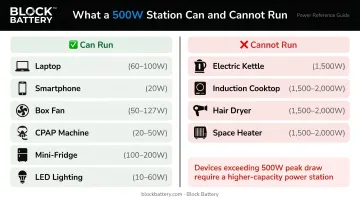
A 500W continuous AC output means the inverter can sustain roughly 500 watts of load. Run one device above that threshold — an electric kettle, a hair dryer, a space heater — and the station will either shut down or trigger its surge protection.
What a 500W Station Can and Cannot Run
| Device | Typical Draw | 500W Station? |
|---|---|---|
| Laptop | ~60–100W | ✅ Yes |
| Smartphone charger | ~20W | ✅ Yes |
| Box fan | ~50–127W | ✅ Yes |
| CPAP machine (travel) | ~20–50W | ✅ Yes |
| Compact mini-fridge | ~100–200W | ✅ Yes (limited runtime) |
| LED lighting | ~10–60W | ✅ Yes |
| Electric kettle | ~1,500W | ❌ No |
| Induction cooktop | ~1,500–2,000W | ❌ No |
| Hair dryer | ~1,500–2,000W | ❌ No |
| Space heater | ~1,500–2,000W | ❌ No |
Understanding Runtime Math
Watt-hours divided by device wattage gives you a theoretical runtime figure. A 500Wh battery running a 50W CPAP machine lasts approximately 8–10 hours, while that same battery running a full 500W appliance drains in under an hour.
One caveat worth knowing: manufacturers and independent testing both confirm that usable capacity runs 80–90% of the nameplate figure due to inverter conversion losses and internal systems. Plan on 400–450 usable watt-hours from a 500Wh station, not 500.
The 500W category handles device charging, fans, CPAP machines, and compact coolers well. Anyone planning to cook electrically, run a full-size refrigerator continuously, or power high-draw tools should step up to a 1,000Wh+ station — or pair a 500W unit with solar panels to extend runtime.
Best 500 Watt Portable Power Stations for 2026
These five stations were selected based on battery chemistry, real-world output reliability, charging speed, port diversity, and value — drawing on publicly available manufacturer specifications, third-party test data, and Block Battery's two decades of professional battery engineering experience.
EcoFlow River 2 Max 500
EcoFlow is one of the most recognized names in portable power, and the River 2 Max 500 is their US flagship in the compact 500W LFP category — built for both everyday off-grid use and emergency backup.
The standout differentiators:
- LiFePO4 chemistry rated to 3,000 cycles to 80% capacity
- X-Boost technology manages wattage draw to run devices rated up to 1,000W (note: load management, not true 1,000W continuous output)
- Recharges from 0–100% in ~60 minutes — one of the fastest in this class
| Spec | EcoFlow River 2 Max 500 |
|---|---|
| Capacity / Chemistry | 499Wh / LiFePO4 |
| AC Output | 500W continuous, 1,000W surge |
| Weight | 13.2 lb |
| AC Recharge Time | ~60 minutes |
| Warranty | 5 years |
| Approx. Price | $289–$499 |
Jackery Explorer 500 V2
Jackery was founded in California in 2012 and helped define the consumer portable power station category. Their iconic orange design and camping-focused ergonomics remain, but the Explorer 500 V2 — which debuted at IFA 2025 and became available September 19, 2025 — brings a notable upgrade: LiFePO4 chemistry replacing the older NMC cells in the original Explorer 500.
Key differentiators:
- 512Wh LFP capacity — slightly more stored energy than the EcoFlow's 499Wh US spec
- 200W maximum solar input with broad compatibility across Jackery's SolarSaga panel lineup
- Handle-integrated design at 12.6 lb, purpose-built for portability
| Spec | Jackery Explorer 500 V2 |
|---|---|
| Capacity / Chemistry | 512Wh / LiFePO4 |
| AC Output | 500W continuous, 1,000W peak |
| Solar Input | 200W max |
| Weight / Dimensions | 12.6 lb / 31 × 20.5 × 15.6 cm |
| Warranty | 5 years (3 + 2 extension) |
| Approx. Price | ~$319 (Amazon US) |
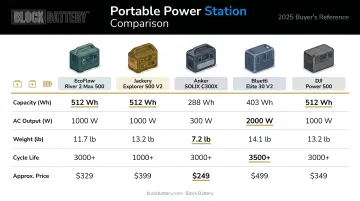
Anker SOLIX C300X
Anker entered the portable power station market focused on compact, feature-rich units. The C300X (sold at Best Buy; Anker's own site lists it as the SOLIX C300) is their smallest AC-capable station — genuinely shoebox-sized and light enough to clip a shoulder strap to and carry like a bag.
Key differentiators:
- Shoulder-strap portability sets it apart from box-style competitors
- Multiple output port types: AC outlets, USB-C, USB-A, and 12V car socket
- A DC-only variant (SOLIX C300 DC) exists for users who don't need AC at all
Important caveat: The C300X is a 288Wh, 300W continuous station — not a true 500W unit. It belongs on this list for its 600W surge capability and its role as the most portable AC option in the category, but buyers needing sustained 500W output should choose the EcoFlow or Jackery instead.
| Spec | Anker SOLIX C300X |
|---|---|
| Capacity / Chemistry | 288Wh / LiFePO4 |
| AC Output | 300W continuous, 600W surge |
| Output Ports | AC, USB-C, USB-A, 12V car socket |
| Approx. Weight | ~9 lb |
| Approx. Price | $249.99 (Best Buy) |
| Warranty | Verify current SKU warranty before purchasing |
Bluetti Elite 30 V2
Bluetti built its reputation on LFP chemistry — even in budget-tier products. The Elite 30 V2 is the current recommended model, replacing the older EB3A, and represents their compact everyday-essential station.
Key differentiators:
- 600W continuous AC output — slightly above the 500W category baseline
- Power Lifting mode handles up to 1,500W for resistive loads (heating elements, not motors)
- WiFi and Bluetooth app control for remote power monitoring
- At 9.48 lb, the lightest full-featured station in this comparison
| Spec | Bluetti Elite 30 V2 |
|---|---|
| Capacity / Chemistry | 288Wh / LiFePO4 |
| AC Output | 600W continuous / 1,500W Lifting Power |
| Weight | 9.48 lb |
| App Compatibility | WiFi + Bluetooth |
| Warranty | 5 years |
| Approx. Price | ~$219 |
DJI Power 500
DJI — best known for professional drones and cameras — entered the power station market with a specific audience in mind: filmmakers, photographers, and content creators. The Power 500 reflects that focus in ways the other four stations don't.
Key differentiators:
- Runs at ~25 dB during recharge — near-silent for on-set use or active recording
- SDC Lite port fast-charges select DJI drone batteries (Mavic 3, Air 3 series) without an adapter
- 4,000 cycles to 70% capacity — the longest documented cycle life in this group (note: different endpoint than the 80% benchmark other brands use)
- At 16.1 lb, it's the heaviest station here — the tradeoff for its 1,000W continuous AC ceiling
| Spec | DJI Power 500 |
|---|---|
| Capacity / Chemistry | 512Wh / LiFePO4 |
| AC Output | 1,000W continuous (battery above 20%) |
| Noise Level | ~25 dB (Standard Recharge Mode) |
| Weight | 16.1 lb |
| Ports | 2× 100W USB-C, 2× 24W USB-A, AC outlets, SDC Lite |
| Warranty | 5 years |
How We Chose the Best 500W Power Stations
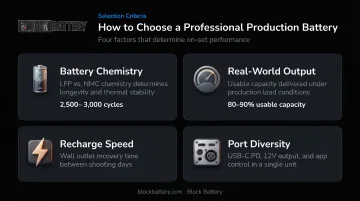
Selection was based on four primary criteria:
Battery chemistry — LFP preferred over NMC for cycle longevity and thermal safety. Battery University documents LFP's thermal runaway threshold at ~270°C vs. ~210°C for NMC — a 60°C buffer that matters when a unit is left charging unattended. All five stations above use LFP.
Real-world output reliability — usable AC power runs 80–90% of claimed capacity, so independently tested figures matter more than manufacturer specs alone.
Recharge speed — how quickly the station recovers from a wall outlet matters in real-world use, especially for emergency preparedness and travel.
Port diversity and ease of use — USB-C PD, 12V car sockets, and app control distinguish practical everyday stations from spec-sheet competitors.
Two Common Buying Mistakes
- Confusing Wh and W: A 500Wh battery and a 500W output station are two different things. You need both specs — they measure different things.
- Buying no-name brands: The CPSC has issued warnings about off-brand lithium-ion power stations, including one case where Aeiusny stations posed explosion and fire risks. Stick to brands with documented UL 2743 certification or equivalent safety testing.
Beyond specs and safety, weight shaped the final list too. The five stations here range from 9 to 16.1 lb — reasonable for the 500W class. The DJI's heavier footprint earns its place through a 1,000W AC ceiling and silent-operation engineering. Units pushing past 20 lbs in this category rarely justify the added bulk.
Conclusion
The 500W portable power station is one of the more practical categories in consumer electronics right now. Battery chemistry, real-world output, and recharge speed should drive the decision — not the wattage claim on the box.
For campers, van lifers, and emergency preparedness buyers, any of the five stations above will serve well depending on budget and priorities: the EcoFlow for fastest recharge, the Jackery for the best solar input, the Bluetti for lightest weight, the Anker for ultimate portability, and the DJI for creative professionals who need silent operation.
Film, broadcast, and commercial video production are a different category entirely. Consumer 500W stations don't fail because they're underpowered — they fail because their voltage architecture and sustained-current tolerance aren't built for production environments. Block Battery, a veteran-owned Indianapolis manufacturer with 30 years in the professional broadcast and cinema battery industry, builds for that gap:
- SLi series (300–1,000Wh): A-camera and mid-tier production, V-Mount / Gold-Mount / B-Mount compatible
- INDY series (3,000–6,000Wh, 14.4V/24V/28.8V/30V): lighting production, aerial cinematography, and video village setups
For on-set, rental-house, or production-specific power guidance, reach out through the Block Battery dealer network or contact the team directly at blockbattery.com.
Frequently Asked Questions
What can a 500 watt power station run?
Laptops, smartphones, fans, CPAP machines, LED lighting, and compact mini-fridges on low draw all fall within range. Electric kettles, induction cooktops, hair dryers, and space heaters typically draw 1,500–2,000W and will exceed any standard 500W station's continuous output limit.
How long will a 500W power station last?
Runtime depends on your device's wattage divided into the station's usable capacity (plan on 80–90% of the claimed Wh figure). A 500Wh station running a 50W CPAP lasts roughly 8–10 hours; running a 500W appliance drains it in under an hour.
What is the difference between 500 watts and 500 watt-hours?
Watts measure the maximum power the station can deliver at any single moment. Watt-hours measure total stored energy. A station can have a 500W output and 512Wh capacity — both specs matter, and they measure completely different things.
Is a 500W power station enough for camping?
Yes, for most device charging, LED lighting, a fan, and a CPAP machine. If you plan to cook electrically or run a full-size cooler across multiple days, consider a 1,000Wh+ station or pair the 500W unit with a compatible solar panel to recover capacity between uses.
Can a 500W power station run a mini-fridge?
Most 500W stations can run a compact mini-fridge drawing 100–200W. At a continuous 100W draw, a 500Wh station provides roughly 4–4.5 hours of runtime using the 80–90% usable-capacity estimate. Compressor cycling may extend total runtime modestly.
What battery type should I look for in a 500W power station?
Choose LFP (LiFePO4) over NMC lithium-ion. LFP is rated for 2,500–3,000+ cycles to 80% capacity versus roughly 500 cycles for NMC, and its higher thermal runaway threshold makes it meaningfully safer — particularly relevant given documented CPSC incidents involving off-brand lithium-ion stations.