Introduction
The Sony PMW-500 is a proven shoulder-mount broadcast camera built for demanding work where power failure isn't an option: live news, documentary, sports, and multi-camera ENG production. Its native V-mount rear plate makes battery choice straightforward in one sense and critical in another — the wrong battery can cut a shoot short, damage accessories, or get flagged at airport security.
This guide covers everything PMW-500 operators need to make a confident battery decision: Sony's actual power specs, how to match capacity to your shoot type, and what separates a professional-grade V-mount pack from a liability. Recommendations throughout come from Block Battery, a veteran-owned US manufacturer with 30 years of broadcast and cinema battery experience.
Why the PMW-500 Is Built for V-Mount Power
A Native Mount, Not an Afterthought
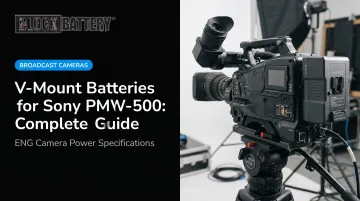
The PMW-500 ships with a V-mount (V-lock) plate integrated directly into the rear of the camera body. A standard V-mount battery clicks in and you're working — no adapter plates, no conversion hardware required. That field-readiness is by design: shoulder-mount broadcast cameras need power systems that disappear into the workflow, not slow it down.
The camera also features a video light connector on the top handle rated at 50W maximum, which allows compatible accessories like on-camera lights to draw power through the camera itself. This makes the rear battery the power source for your entire rig, not just the camera body — a workflow consideration that directly shapes which battery capacity you need.
V-Mount vs. BP-U: Why Broadcast Chose Differently
That rig-level power demand is exactly why V-mount became the broadcast standard. Smaller Sony cameras in the prosumer range use the BP-U battery system — compact, lightweight, and suited for handheld solo work. Shoulder-mount operators needed something more:
- Higher capacity per pack, supporting longer uninterrupted takes
- Hot-swap capability without powering down the camera
- Broader accessory ecosystem — monitors, lights, transmitters all commonly run off V-mount
- Industry-wide standardization across most broadcast and cinema platforms
A V-mount battery bought for your PMW-500 moves freely across your kit — compatible lights, monitors, and transmitters on other productions draw from the same system.
Sony PMW-500 Power Requirements
Voltage and Draw — the Two Numbers That Matter
Sony's official PMW-500 documentation specifies:
- DC input: 12V nominal, 11V to 17.0V operating range
- Body-only power draw: approximately 27W (during recording with LCD lit)
- Full configuration draw: approximately 33W with viewfinder, lens, and microphone
Standard 14.4V nominal V-mount batteries land squarely inside that 11–17V window. High-voltage V-mount packs — the 26V or 28V variants designed for LED fixtures and large-format cinema cameras — exceed the PMW-500's 17V maximum. Never connect them directly to this camera without a regulated step-down converter.
Planning for Accessory Load
Staying within that voltage window is only half the equation. The 27W body draw is your floor, not your ceiling — once you start powering accessories off the camera or directly off the battery, load climbs fast:
| Accessory | Approximate Draw |
|---|---|
| On-camera LED light | ~25W |
| 9" SDI field monitor | ~18W |
| Wireless video transmitter | ~9W |
| Camera body (recording) | ~27W |
| Full ENG rig total | ~62–79W |
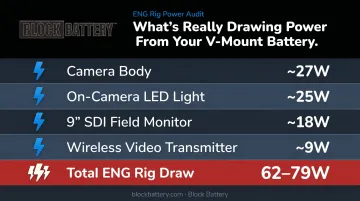
Those totals make BMS quality a hard requirement — not a spec-sheet checkbox. A professional Battery Management System covering overvoltage, undervoltage, overcurrent, and short-circuit protection is what stands between a stacked 62–79W load and a damaged $30,000+ camera. Budget batteries with weak protection circuits are a direct liability in this configuration.
Key Features to Look for in a V-Mount Battery
Capacity Tiers and What They Actually Mean
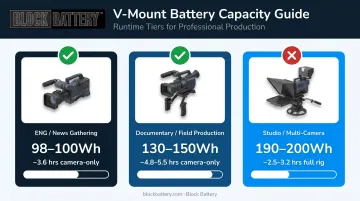
V-mount batteries for broadcast work cluster into three practical tiers:
- 98–100Wh — Flyable under TSA/IATA rules without airline pre-approval. At the PMW-500's 27W body draw, a 98Wh pack delivers a calculated ~3.6 hours camera-only. Right-sized for run-and-gun ENG with a two-battery rotation.
- 130–150Wh — Requires airline approval to carry on (101–160Wh tier). At 27W body draw, theoretical runtime climbs to ~4.8–5.5 hours camera-only. The practical sweet spot for documentary and field production.
- 190–200Wh — Generally not permitted as passenger carry-on above 160Wh. With a full ENG rig (camera + light + monitor at ~62–77W combined), calculated runtime is ~2.5–3.2 hours — meaningful for extended outdoor productions, but the math shows accessories eat capacity fast.
Airline Carry-On Compliance
TSA regulations and IATA 2026 passenger guidance align on the same thresholds:
- ≤100Wh: Allowed in carry-on, no approval needed
- 101–160Wh: Allowed with airline/operator approval, maximum two spare batteries
- >160Wh: Not permitted for passenger carriage
For broadcast crews who fly regularly, the 98–100Wh tier is the simplest choice. Batteries in the 130–150Wh range require a call to the airline before you head to the airport.
Display, Build, and Charging
Once you've sorted compliance and capacity, three hardware details separate reliable field batteries from ones that create problems on set:
- State-of-charge display: LED bar indicators give rough estimates. OLED or LCD displays showing real-time voltage, current draw, and runtime in minutes are worth the premium — an unexpected shutdown mid-interview costs far more than the price difference.
- Build quality: ENG batteries take real abuse — dropped tailgates, vehicle vibration, outdoor temperature swings. The V-mount locking mechanism is the critical point. A battery that wobbles or disconnects under vibration is a problem you don't want to find during a live shot.
- Charging system: Multi-channel simultaneous chargers let you cycle batteries without waiting — essential on 12-hour shoot days. Verify charger compatibility with your specific battery model before assuming it's universal.
Matching Battery Capacity to Your Shoot Type
ENG and News Gathering
Fast-moving news work comes down to two priorities: light kits and flyable batteries. A pair of 98–100Wh batteries in rotation — one on camera, one charging in the live truck — covers most breaking news scenarios without exceeding TSA carry-on limits. At ~3.6 hours theoretical runtime per pack on the camera body alone, you'll rarely drain one before the second is ready.
Documentary and Extended Field Production
When ENG discipline gives way to multi-hour outdoor shoots and remote locations with no reliable power access, the capacity math shifts — you need 130–150Wh. At body-only draw, a 150Wh pack runs the PMW-500 for a calculated ~5.5 hours. Pair it with a light and monitor and you're looking at roughly half that — still enough for a half-day block before swapping.
Key considerations for extended field work:
- Runtime buffer: a 150Wh pack gives ~5.5 hours on the body alone
- Accessory draw: adding a light and monitor cuts that to ~2.5–3 hours
- Swap strategy: carry two packs minimum for full-day remote shoots
Studio and Multi-Camera Production
Weight matters less in studio configurations, and battery swap frequency matters more. Larger capacity packs reduce interruptions and let operators focus on the shot. In setups with a V-mount power distribution plate feeding the entire rig from one battery, high-capacity packs become the obvious choice regardless of airline concerns.
Block Battery V-Mount Recommendations for the PMW-500
Block Battery is a veteran-owned American manufacturer based in Indianapolis, IN. The company's management team brings 30 years of experience in the professional broadcast and cinema battery industry, and their products are built specifically for production environments — distributed through an authorized dealer network across North America, South America, the Middle East, and Japan.
Models Relevant to the PMW-500
For the PMW-500's 14.4V V-mount platform, Block Battery's most applicable options span from compact ENG use to extended field production:
| Model | Capacity | Voltage Output | Best For |
|---|---|---|---|
| 2F1-150 | 150Wh | 14.4V, 24V, 28.8V, 30V | ENG/documentary, field production |
| SLi-300 | 300Wh | 14.4V, 24V, 28.8V, 30V | Extended documentary, multi-accessory rigs |
| SLi-500 | 500Wh | 14.4V, 24V, 28.8V, 30V | Studio/multi-cam, sustained-duty field |
| SLi-600 / HC600 | 600Wh | 14.4V, 24V, 28.8V, 30V | High-current lighting + camera rigs |
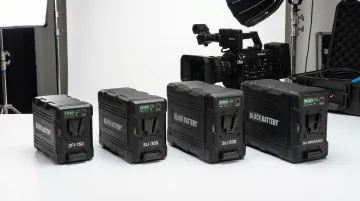
The 2F1-150 is the compact entry point — purpose-built for run-and-gun ENG, rugged enough for weather exposure and helicopter rigs, and available in V-mount configuration. The SLi series scales up for productions running heavier accessory loads or needing fewer swaps across long shoot days.
For specific continuous amp ratings, D-Tap output specs, and pricing through an authorized dealer, contact Block Battery directly at blockbattery.com or email normk@blockbattery.com.
Quick Selection Checklist
Before purchasing any V-mount battery for the PMW-500, confirm:
- ✅ Voltage range: 14.4V nominal, compatible with 11–17V input
- ✅ Not a 26V/28V high-voltage pack
- ✅ D-Tap output port for accessory power
- ✅ BMS covering overvoltage, undervoltage, overcurrent, and short circuit
- ✅ Capacity matches your shoot type and travel requirements
- ✅ Locking V-mount connector rated for field use
Tips for Getting the Most Out of Your V-Mount Battery on Set
Hot-Swap Protocol
The PMW-500's V-mount plate supports quick swaps — with practice, you can change batteries without fully powering down. Always label batteries by charge state during busy productions. On shoots with multiple cameras, a shared labeling system (masking tape and marker is fine) prevents a half-dead battery from going back on camera unnoticed.
D-Tap Load Management
Add up the wattage of every accessory before plugging in. A 25W light plus an 18W monitor plus a 9W wireless transmitter is 52W before the camera body's 27W — that's 79W total. If your battery isn't rated for that sustained draw, you'll see voltage sag or unexpected shutdowns. Know your total load before you connect anything.
Storage and Maintenance
Battery University recommends storing lithium-ion cells at approximately 40% state of charge for long-term storage. Leaving packs fully charged or fully depleted in a hot vehicle accelerates capacity loss. Most Li-ion cells are rated for 300–500 charge cycles before meaningful degradation — storage conditions directly affect how many of those cycles you actually get.
Frequently Asked Questions
How much does a Sony camera battery cost?
V-mount batteries for professional Sony broadcast cameras like the PMW-500 typically range from around $150–$280 for 98–100Wh options to $300+ for higher-capacity professional units. Block Battery prices are custom-quoted — contact blockbattery.com or your authorized dealer for current pricing.
What voltage does the Sony PMW-500 require from a V-mount battery?
The PMW-500 operates on 12V DC nominal with an input range of 11V to 17V. Standard 14.4V nominal V-mount batteries are the correct choice. High-voltage 26V or 28V V-mount packs exceed this range and require a step-down converter before connecting to this camera.
How long will a V-mount battery last on a Sony PMW-500?
At the camera's body-only draw of approximately 27W, a 98Wh battery delivers roughly 3.5–3.7 hours of calculated runtime. Add a light and monitor via D-Tap and total draw can exceed 60W, cutting that figure significantly — plan for 1.5–2 hours under a full accessory load.
Can I use any V-mount battery with the Sony PMW-500?
Most standard 14.4V V-mount batteries are mechanically and electrically compatible with the PMW-500's built-in plate. The critical exceptions are high-voltage (26V/28V) packs. Always prioritize batteries with a properly rated BMS to protect the camera and downstream accessories.
What is the difference between V-mount and Anton Bauer batteries for the PMW-500?
V-mount (V-lock) and Gold Mount (Anton Bauer) are competing professional battery standards that both operate in the 14.4V nominal class with similar capacity offerings. The PMW-500 has a native V-mount plate — Gold Mount batteries require an adapter plate to fit.
Do V-mount batteries work with the video light connector on the PMW-500's handle?
The PMW-500's 50W-rated video light connector draws directly from the V-mount battery on the rear plate. Verify your battery's continuous discharge rating can handle the combined camera body and accessory load without voltage sag.