
Introduction
The ARRI Alexa 65 is one of the most demanding large-format cinema cameras ever put into production. With that comes a power architecture that trips up even experienced crews: two distinct voltage rails — one for main camera power, one for accessories — that must never be confused.
The most common mistake on set? Treating the 12V accessory outputs as interchangeable with the 24V main input, or grabbing a standard 14.4V V-mount battery and expecting the camera to turn on. Neither works. The results range from a dead camera at call time to a fried accessory port.
This article breaks down what each voltage rail does, what its operating limits are, and how to spec power correctly for the Alexa 65 — before you're troubleshooting on set.
Key Takeaways
- The Alexa 65 requires a 24V DC main power input — standard 14.4V V-mount batteries cannot power it
- The 12V ports are outputs, not inputs — they supply power to accessories, not the camera body
- Delivered voltage drops under load; cable length and cell health both affect what the camera actually receives
- Watt-hour capacity sets runtime — voltage stability under peak load sets reliability
- Always verify voltage at the camera connector, not at the battery terminals
What Dual-Voltage Architecture Means in the ARRI Alexa 65
Most cinema cameras operate on a single voltage rail. The Alexa 65 doesn't. It runs two electrically distinct rails simultaneously — one governing main system power, one distributing power outward to connected accessories — and they work in opposite directions.
The 24V Rail: Power In
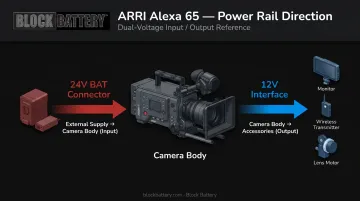
The 24V rail is the camera's primary power input. An external source — a battery pack or AC supply — delivers power to the camera body through the main BAT connector. That power feeds the image sensor, recording system, processing engine, and thermal management. Nothing in the camera works without it.
The 12V Rail: Power Out
The ARRI Rental ALEXA 65 product page confirms the camera includes both a 1 x 12V interface and 5 x RS 24V interfaces alongside the main BAT and ACC connectors. The 12V interface distributes power outward from the camera to connected accessories — it is not a second input and cannot substitute for the 24V main supply.
This direction of current flow matters enormously:
- 24V BAT connector: External supply → Camera body (input)
- 12V interface: Camera body → Accessories (output)
Why 24V for a Camera This Large?
As Victron Energy's electrical reference explains, electrical power follows P = V × I, meaning current equals wattage divided by voltage (I = P/V). A camera drawing well above 100W at 24V pulls roughly half the current it would at 12V for the same power. For a camera of this size and complexity, that difference is consequential:
- Less resistive loss over cable runs
- Smaller required cable gauges
- More stable operation under peak processing loads
ARRI's own B-Mount documentation reinforces this rationale: the B-Mount standard was developed as a 24V system specifically because higher voltage enables more efficient power delivery with compact product design compared to traditional 12V architectures.
The 24V Main Power Input: Specifications, Range, and Operating Limits
What ARRI Confirms
The official ARRI Rental ALEXA 65 product page lists BAT as the main power interface alongside ACC and the accessory ports. The page does not publish explicit voltage range figures (minimum, nominal, maximum) in its publicly available technical data. For exact input voltage range, shutdown threshold, and overvoltage protection behavior, you must consult the current ALEXA 65 technical manual directly from ARRI Rental — these specifications vary by production firmware version and should not be sourced from third-party aggregators.
What the Engineering Context Tells You
Cross-model comparison gives useful context, though it should not be applied directly to the Alexa 65 without ARRI confirmation:
- The ALEXA Mini accepts 10.5–34V DC (ARRI SUP 5.4 manual, 2018)
- The ALEXA 35 accepts 20.5–33.6V DC via its PWR LEMO 8-pin connector (ARRI SUP 6.0.0 manual, April 2026)
The Alexa 65 is a distinct platform with its own specifications. Do not import these ranges into an Alexa 65 power spec without verification.
Voltage Behavior Across the Discharge Cycle
Battery voltage is not static. A fully charged 24V pack typically delivers above nominal voltage at the start of a shoot and drops toward its cutoff threshold as cells discharge. The camera must tolerate this swing. Additional voltage reduction occurs across:
- Cable resistance — governed by V = I × R; longer runs and thinner gauges increase drop
- Connector wear — degraded contacts add resistance at every junction
- Cold temperatures — lithium-ion cells discharge at reduced terminal voltage in cold ambient conditions, per standard lithium-ion discharge curve behavior
Each of these factors reduces effective voltage at the camera's input terminals below what the battery's label states — a distinction that matters when the camera has a minimum operating threshold.
Power Consumption and Current Draw
ARRI does not publish Alexa 65 wattage figures in the public product page. Request idle, active recording, and peak processing wattage from ARRI Rental directly. Once you have the wattage figure, calculate implied current draw using A = W ÷ 24V to determine what your power source must sustain. For a camera drawing 150W, that's 6.25A continuous — rising under peak processing load.
That sustained draw is where battery selection matters. Voltage sag under load and battery swap frequency are real operational concerns on large-format shoots. Block Battery's Pro-Block and SLi-D1000 are built to handle that sustained current demand. Contact Block Battery or an authorized dealer to confirm compatibility and current specifications for your specific configuration.
The 12V Accessory Output Ports: Capacity, Limits, and Use Cases
What's on the Camera
The ARRI Rental ALEXA 65 product page confirms 1 x 12V interface and 5 x RS 24V interfaces. The product page also lists LDD, LCS, and TC I/O connections relevant to lens control and timecode. For connector types, physical locations, current limits, and pinouts — go to the current ALEXA 65 user manual.
How the 12V Rail Works
The 12V interface is an output powered by the camera's internal power conversion from the 24V input. This has a direct operational implication: if the 24V main supply fails or falls below minimum threshold, the 12V accessory output goes with it. Accessories lose power simultaneously with the camera body. There is no independent 12V supply.
Managing Accessory Load
That dependency makes load planning critical — if a single supply event drops the 24V rail, every accessory on the 12V port goes dark at the same moment.
Common accessories that draw from 12V ports on cinema cameras include:
- Wireless video transmitters
- Lens control motors (focus, iris, zoom)
- Small on-camera monitors
- Remote head controllers
Each port carries a maximum current rating. Exceeding it triggers overcurrent protection or damages the port's internal regulator. To manage total 12V load correctly:
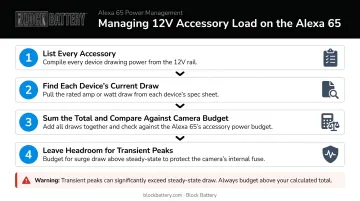
- List every accessory drawing from the camera's 12V interface
- Find each device's current draw from its own spec sheet (amps or watts at 12V)
- Sum the total and compare against the camera's 12V distribution budget per ARRI's documentation
- Leave headroom — don't design to the limit; transient peaks can exceed steady-state draw
Check the ARRI Alexa 65 user manual for per-port current limits before locking your accessory package — those numbers can differ between camera revisions, and designing to the wrong ceiling creates on-set problems that aren't easily solved mid-shoot.
Specifying and Validating Power Sources for the Alexa 65
Reading the Spec Sheet Correctly
When reviewing the Alexa 65 datasheet for power specification purposes, three figures must be satisfied simultaneously:
| Specification | What It Means |
|---|---|
| Rated input voltage | The nominal voltage at which performance specs are guaranteed |
| Minimum operating voltage | Below this, the camera shuts down or refuses to power on |
| Peak current draw | The maximum instantaneous current demand the source must sustain |
A battery that meets nominal voltage but cannot sustain peak current will cause voltage sag — potentially dropping the delivered voltage below the minimum operating threshold mid-shoot.
Measure at the Camera, Not the Battery
Open-circuit battery voltage — measured at the battery terminals with no load connected — is always higher than voltage delivered at the camera connector under operating current. Cable resistance, connector resistance, and current draw determine the difference (V drop = I × R).
Correct verification method:
- Use a calibrated multimeter or inline power meter placed at the camera's power input connector
- Take the measurement under operational load, not with the camera in standby
- Verify across the full expected discharge range, not just at full charge
A battery showing correct open-circuit voltage will sag when the Alexa 65 draws peak processing current. This is particularly relevant when evaluating rental batteries with unknown cell health history versus a maintained, owned battery fleet.
Watt-Hours vs. Voltage Stability
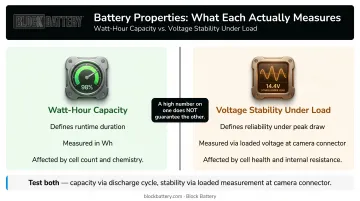
Watt-hour capacity determines runtime. Voltage stability under load determines reliability. These are separate properties, and a high number on one does not guarantee the other.
A 24V battery with degraded cell health may deliver correct open-circuit voltage but fail to hold that voltage when the Alexa 65 demands peak current. Test both — capacity with a discharge cycle, and stability with a loaded voltage measurement at the camera connector.
Common Misinterpretations of the Alexa 65 Dual-Voltage System
Treating 12V Ports as Camera Power Inputs
Crews unfamiliar with the Alexa 65's architecture sometimes attempt to power the camera through an accessory port, or assume the 12V label indicates the camera accepts 12V as its main input. Neither is correct. The 12V interface is an output. Attempting to use it as a power input will not power the camera and risks port damage.
Assuming Nominal Means Delivered
Selecting a battery rated "24V nominal" without accounting for end-of-discharge sag, connector resistance, and cable length is one of the most common power mistakes on set. Under full load with a long cable run, delivered voltage at the camera terminal can drop 1–2V or more below what the battery label states — enough to fall below the camera's minimum operating threshold during peak demand.
Applying Specs from Other ARRI Models
Power specifications vary significantly across the ARRI Alexa family:
- ALEXA Mini: 10.5–34V DC input
- ALEXA 35: 20.5–33.6V DC input, B-Mount 24V native
- ALEXA 65: distinct platform with its own specifications
Accessory port current limits, input voltage ranges, and connector types differ between models. Do not assume figures from the Alexa Mini or Alexa 35 documentation apply to the Alexa 65. Verify every specification against ARRI Rental's current Alexa 65 documentation.
Frequently Asked Questions
What is the power input voltage for ARRI Alexa cameras?
It varies by model. The Alexa 65 operates on 24V DC main power input. The Alexa Mini accepts 10.5–34V DC, while the Alexa 35 accepts 20.5–33.6V DC with a B-Mount native interface. Always confirm the exact voltage range in ARRI's model-specific documentation.
Can you power the ARRI Alexa 65 with a standard 14.4V V-mount battery?
No. A standard 14.4V V-mount battery does not meet the Alexa 65's 24V input requirement and will not power the camera. A dedicated 24V-class power source — such as a high-capacity cinema block battery — is required.
What accessories can be connected to the 12V port on the ARRI Alexa 65?
Common accessories include wireless video transmitters, lens control motors, and small monitors. The ARRI Rental ALEXA 65 page confirms full wireless lens-control support. Each port has a current limit — verify the specific rating from the ARRI user manual before finalizing your accessory package.
What happens if input voltage drops below the Alexa 65's minimum threshold?
The camera will shut down to protect internal components or display a power fault warning. Abrupt shutdowns during recording can corrupt media. Verify your delivered voltage under full load at the camera connector — not at the battery — before shooting.
How do I calculate battery runtime for the Alexa 65?
Divide battery capacity in watt-hours by total system power draw in watts. That total must include all accessories drawing through the camera's 12V port, not just the camera body alone. Get the camera's power consumption figures from ARRI Rental for an accurate calculation.
Is the Alexa 65's power system the same as ARRI's B-Mount standard?
No. B-Mount is ARRI's open 24V standard introduced for newer models like the Alexa 35. The Alexa 65 uses a different connector architecture — its product page lists BAT and ACC interfaces, not a native B-Mount interface. Confirm the exact connector type and required adapters with ARRI Rental before selecting a power source.